Sold! Oklahoma’s Waurika Farms
April 12, 2012 by Land Report Editors
Filed under Auctions, Cattle, Feature, Oklahoma
APRIL 12, 2012 UPDATE:
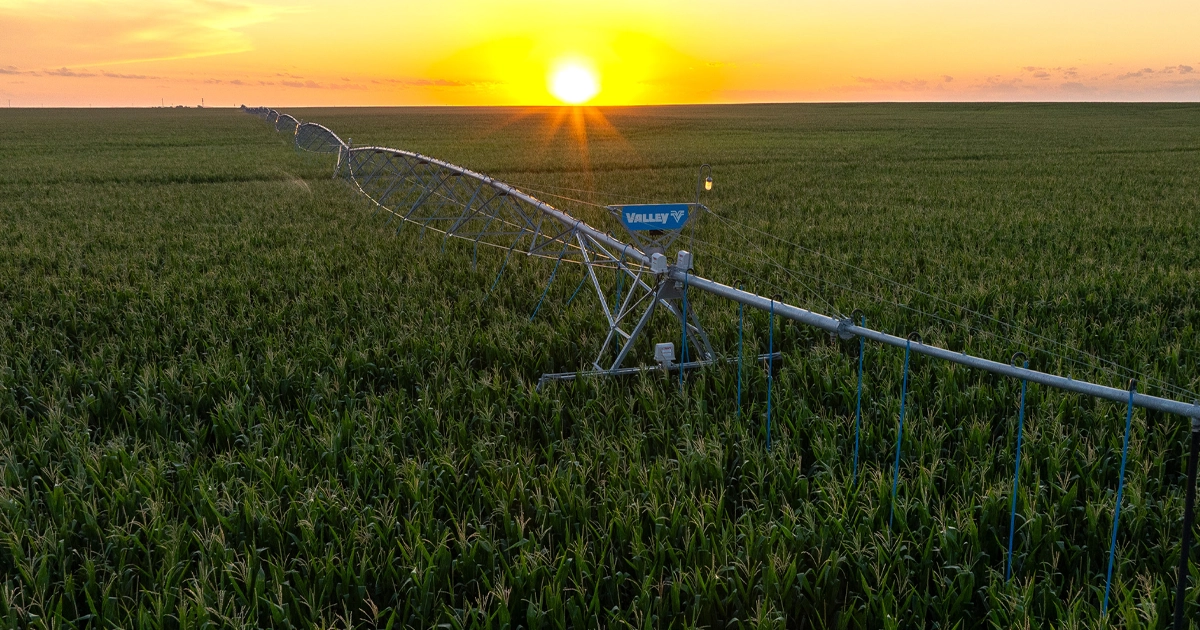
Hall & Hall Auctions auctioned Waurika Farms, one of the largest beef production operations in the Southern Oklahoma, for a whopping $11 million ($1,833 per acre). Pre-sale estimates ranged from $1,300 to $1,500 per acre. Owned by Oklahoma’s Drummond family, the 7,000-acre farm includes 3,300 acres of wheat land and 2,700 acres of Bermuda grass and native species. “We were also able to sell all of the equipment above the sale price,” says Auctioneer Scott Shuman, who noted that 15 registered bidders attended.
MARCH 14, 2012 POST:
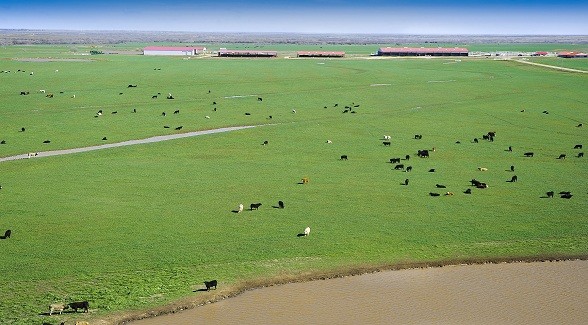
Waurika Farms is one of the largest cattle operations in the area, historically producing two million pounds of beef annually.
At 7,000± acres, Waurika Farms, which is the family beef operation of the well-known Drummond family of Oklahoma. This expertly designed and efficient 21st century stocker cattle operation can run between 8,000 and 10,000 head of stocker cattle annually.
The acreage of this property is comprised of 1,000 acres of privately leased land of native grass, approximately 3,300 acres of wheat land, and about 2,700 acres in mostly Bermuda grass and native species. There are also over 60 ponds throughout the property in the wheat traps and grass traps, providing an excellent source of water for the livestock.
Created to maximize beef production in the most efficient way possible, Waurika Farms includes 30 miles of new fence laid out to accommodate cattle movement with a minimal number of employees. The property also includes a modern headquarters with a good set of pens and scales, a 28,000-sq.-ft. shop building, a covered arena, an outdoor working arena, and the owner’s home. There are five other working pens and two other sets of scales on the farm.
Auction Date: April 12, 2012 at 1:30 PM CST
Information Dates: March 21, 2012 and March 29, 2012 from 1-4 PM CST
Location: Waurika Farms Headquarters, Waurika, OK
For more information or to request a showing, contact Scott Shuman at (800) 829-8747, John Wildin at (620) 662-0411, or visit www.HallHall.com.
Trail Boss – The Bob Funk Story
October 28, 2011 by Eric OKeefe
Filed under 2010 Fall, Cattle, Eric OKeefe, Feature, Great Plains, Gustav Schmiege, West
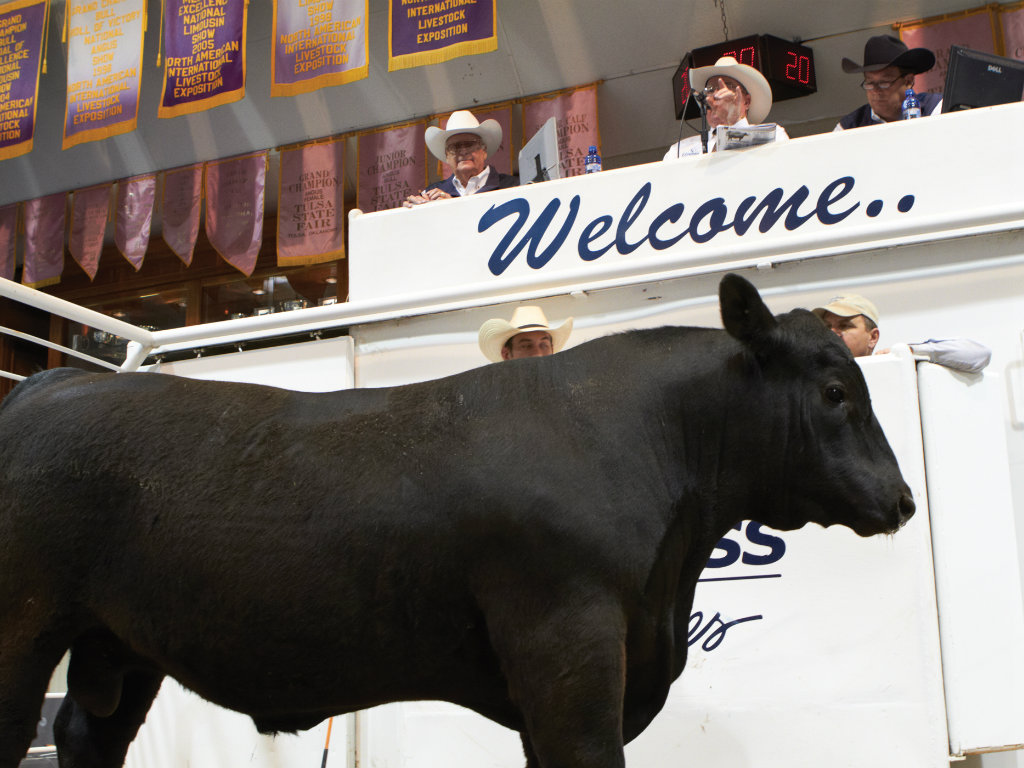
The name says it all: The Big Event. Those who have never had the good fortune to set foot in the Express Ranches Sale Barn have no inkling of the beehive buzzing under the big top. In one corner, eager servers tote trays of tri-tip, biscuits, and brownies to buffet tables where more than 400 will break bread in the next 90 minutes. At the shoeshine stand, cattlemen and their brides queue up two and three deep to have their boots given that like-new look. Lording over the entire affair, auctioneer Eddie Sims barks out bids as the price of a half-interest in an Angus cow and her calf soars past $100,000.
Arms folded, eyes twinkling, Bob Funk sits in the middle of this extravaganza. Garbed in true cowman style, Funk’s distinguishing trait is actually his smile. Could it be because he’s chatting with his girlfriend and his son? Or is his contagious grin because friends have flown in from across the country? Then again, there’s a pretty good chance that Funk’s smile might be directly tied to the sound of Sims’s gavel, which just came down at $195,000.
At first glance, Funk’s credentials stand out as boardroom caliber, not the sales-barn sort. As the chairman and the chief executive officer of Express Employment Professionals, Funk oversees a thriving organization with more than 550 offices in four countries and projected revenues in excess of $2 billion this year.
The largest privately-held staffing company in the U.S., Express Employment is a heavyweight in the human resource industry. Unlike many of its competitors, Express Employment has gained market share during the economic uncertainties of the Great Recession. Through the second quarter of 2011, Express has seen double-digit growth for six consecutive quarters. Since 2009, the Oklahoma City company has nearly doubled in size. Sales are up a robust 92 percent.
Given this track record, it’s no surprise that the number of boards that vie for Funk’s time and support is mind boggling. Churches, schools, and even Uncle Sam have come calling. Funk was chosen as a director of the Tenth Federal Reserve District, the seven-state region that anchors the heart of the Great Plains. Initially appointed to the Oklahoma City branch, he then joined the board of directors of the Kansas City Fed, was chosen chairman, re-elected chairman, and, in 2007, selected as the chairman of the Federal Reserve’s Conference of Chairmen. Funk advised the Board of Governors of the Federal Reserve System, including former Fed chair Alan Greenspan and current chair Ben Bernanke. “Don’t go telling too many people that. They might hold it against me,” he says and bursts out laughing.
Yet the truth is Funk is equally at home on the range or behind a desk. For that matter, he can hold his own on the altar as well. Few people realize that this civic leader, this rancher and cowman is also an ordained minister who earned undergraduate and graduate degrees in theology from Seattle Pacific University while studying business. His broad range of interests is fueled by a level of energy that can best be described as boundless.
During a three-month span this summer, the 71-year-old journeyed to Italy to officiate at the wedding of a close friend, traveled to Scotland to dine with Prince Philip, landed not one but two hundred-pound halibut off Canada’s Queen Charlotte Islands, and escorted the Duke and the Duchess of Cambridge to the Calgary Stampede aboard an Express Ranches stagecoach that was drawn by four of his champion black-and-white Clydesdales.
The secret of his success? No matter the venue, Funk applies the lessons he learned from those he loved growing up on the land. These building blocks have led to a series of successes he readily admits he could never have imagined. They have allowed him to make countless acts of generosity. Most of all, they have given him a mission, one he pursues day in and day out: Bob Funk believes it is absolutely essential to instill those same lessons in the hearts and the minds of youngsters growing up today.
So it’s safe to assume that Funk grew up enjoying the many activities he endeavors to share with kids across Oklahoma, right? Think again.
“We were very poor at home,” says Bob’s older sister, Joanne Benton. “Bob didn’t get to go and participate in county fairs like most kids we knew growing up. He was too busy working for Adolph.”
The mere mention of this older cousin’s name puts a smile on Funk’s face. This tough taskmaster was the wellspring of Funk’s ferocious work ethic. In his barns and on his fields, Funk learned leadership tenets that would build a multi-billion-dollar company.
“Adolph Hanish started at 6:00 a.m. and finished milking 60 cows at midnight every night, seven days a week. And he didn’t think that was working too hard. He loved his cows. They were his life. Adolph taught me a good work ethic. So did Dad. Dad just loved to work. He loved the land. He loved his cattle. My dad worked cows at all times, even after he went broke in the dairy business. He spent more money on his cattle than he should have: the best hay, the best grain. After he went to work for the highway department, he still kept some cows. He’d go milk four cows by hand every morning, start his job at 8:00, finish at 4:30, and milk cows until 7:00 every night. And that was just standard for our family. Dad was a hard worker. He was a wonderful man,” Funk says.
The formative influence of these hardworking men had some unexpected consequences, namely, cheap shots from childhood friends. “Some of our cousins used to call Bob ‘nothing but a dumb farm boy,’” says his sister. “They would make fun of him for working so hard for Adolph.”
There are two sides to this anecdote, and they reveal the mettle of the man. Ask Bob Funk about his cousins’ taunts and he dismisses the personal discomfort that every adolescent endures. Instead, he speaks of the journey of a fellow human being.
“Adolph was a single man who never took a day off. His whole life was his cows. When I started working for him, he had gone 17 years without a day off. The Fourth of July, Thanksgiving, Christmas — he worked holidays, he worked when he was sick, he worked no matter what. I was glad to give him a break,” Funk says.
Ask his sister, however, and another side to her younger brother emerges. “Those boys couldn’t have known it, but what they were doing was challenging Bob. They challenged him to make something of himself, and he sure did,” Joanne says.
For some inexplicable reason, cousins have shaped Funk’s life. Hanish, his father’s cousin, helped mold the young boy into manhood. Decades later, one of his mother’s cousins opened a new chapter in his life by steering him out west.
Most Americans know Ed Pease for his service as an Indiana Congressman. But in Northern New Mexico, the Eagle Scout is known for his service at the legendary Philmont Scout Ranch. The 137,000-acre ranch is nestled in the Sangre de Cristo Mountains, the heart of the historic Maxwell Land Grant (see “Lucien Maxwell,” Land Report Fall 2008). The grant’s 1.7 million acres had been divvied up into a series of enormous ranches, and some 300,000 acres were acquired by legendary Oklahoma oilman Waite Phillips. It was his bequest that created the Scout Ranch.
In 1996, Pease learned that a key inholding was about to change hands. “Word got out that the Atmore Ranch was going to be sold and then cut up into 20-acre parcels. I support a landholder’s rights to do what they see fit with their property, but the idea of walking through a subdivision to get to the biggest mountain on Philmont ruins the concept of hiking through the wilderness, doesn’t it?” Pease asks.
Pease knew the clock was ticking. “In all the time I’ve known Bob, I never ever asked him to do anything financial. But this time I had to. I called him and made the pitch. Bob had never been a Scout as a kid. Growing up he was too busy working to have time to be a Scout. There was no reason for him to buy this ranch. But he knew what it would mean to generations of Scouts to come, so he went ahead and bought it,” Pease says.
Ten years after acquiring the Atmore, Funk expanded his New Mexico holdings when he bought from Brad Kelley the portion of Philmont that Waite Phillips kept for himself. Called the UU Bar Ranch, it is a Rocky Mountain paradise that rises from the high-desert rangeland at 6,000 feet to more than 11,000 feet above sea level in the Sangre de Cristos.
“The UU Bar is more like a state than a ranch,” says former Oklahoma Governor Frank Keating. “You have those alpine meadows, the beautiful forests, the abundant wildlife. It’s absolutely a colorful affirmation of the beauty of America, a spectacular picture-postcard ranch.”
Keating’s wife, Cathy, concurs. Like her husband, Oklahoma’s former First Lady has been a regular at the UU Bar since before Funk bought it.
“We’ve been elk hunting with Bob every year since he bought the Atmore. There’s really just nothing quite like that country out there. It’s just a very special place. You’re in God’s country. I love those moments at the UU Bar – the early morning breakfasts at the lodge that Ralph [Knighton] prepares, driving up to the meadows and waiting for the bugling to start. Then you hear the bugling and the thrill of the chase. I really don’t care if I shoot or not,” she says.
As memorable as a visit to the UU Bar may be, the vast property is an integral element of the Express Ranches portfolio. This multifaceted beef production entity is driven by one goal: better cattle. On a trip to New Mexico, Funk points out that yearling bulls are conditioned on the UU Bar before being taken back to Yukon and sold.
“Jarold likes to tell me we beta test our genetics at the UU Bar,” Funk says, referring to Jarold Callahan, president of Express Ranches. The two teamed up in the mid-1990s when Funk negotiated the purchase of the B&L Ranch and the B&L Angus cow herd near Shawnee from the Oklahoma Cattlemen’s Association Foundation. Up till then, Funk had focused primarily on Limousin cattle. With the purchase of the B&L, Angus cattle became the driver in the expansion of the Express Ranches brand and Callahan was put in charge. “I told Jarold, ‘You sold me these suckers. You come and make them pay,’” Funk says. And that’s exactly what those black-faced cattle have done. According to National Cattleman, Express Ranches is the nation’s largest seedstock operation. Judging from the strong sales numbers at this year’s Big Event, that ranking is safe and secure.
So what does this mean to Bob Funk? It goes without saying that there’s a sense of accomplishment. Back in 1996, he, Callahan, and their team set out to become No. 1, and they’ve done exactly that. It’s the same exact approach that Funk has taken at Express Employment Professionals: putting a team together, setting a high bar, and doggedly pursuing that goal. In three or four years, Express Pros will also be No. 1, Funk tells me.
Bob Funk Jr. is also drawn to the rhythm of the cattle business. His day job may be president of the Oklahoma City Barons, but in the back of his mind are lessons he learned years ago.
Like his father, he insists those lessons be shared. Both men are passionate supporters of the Oklahoma Youth Expo. The organization’s director, Jeremy Rich, tells me that thanks to the Funks, the Expo has gone from near extinction in 2001 to the largest junior livestock show in the nation. I think I know why.
“Growing up in Piedmont, I actually enjoyed working cattle,” Bob Funk Jr. tells me. “Dad used to take me out to feed. It was a hobby, for him and for us, getting up and going to feed the cattle in the morning. It was always fun. It never seemed like work. The best part was really just spending time with Dad.”
On the Block: Oklahoma’s Bird Creek Ranch
June 2, 2011 by Land Report Editors
Filed under Auctions, Cattle, Feature, Hunting, Recreation, Southwest
UPDATE: Bird Creek Ranch sold as one parcel for $1.995 million ($1,304/acre) at public auction in Tulsa on May 23. The 1,530-acre holding was offered in 11 tracts ranging from 20 to 320 acres. More than 70 individuals attended the auction with 36 registering as bidders.
“The local real estate community seemed to be impressed with the outcome of the auction and many registered bidders expected the land to sell for under $1,000 per acre,” said Scott Shuman. “As a result of the auction we have now been asked to look at several other parcels of land for potential auctions. It was a great way to introduce the auction division of Hall and Hall.”
ORIGINAL POST: Hall and Hall Auctions will open the bidding on Bird Creek Ranch Monday afternoon, May 23, at one p.m (CST). The ranch’s 1,530± acres, which are located just minutes from downtown Tulsa, will be offered in 11 tracts ranging from 20 to 320 acres. All tracts have extensive frontage on paved Tulsa County roads. The southeast side of the property borders Bird Creek.
“Bird Creek is ideal for the investor seeking to increase his or her portfolio, or a local farm operator expanding an operation,” says Scott Shuman, who heads up Hall and Hall Auctions. “For the hunter or outdoor enthusiast, this property offers a tremendous opportunity.”
The multi-parcel method of sale will be used to allow ranchers, farmers, investors, hunters, and outdoor enthusiasts to bid on individual tracts or the combination of tracts that best suits their needs.
Scott Shuman
Hall and Hall
(800) 829-8747
Southwestern States Enduring Extreme Drought
May 31, 2011 by Land Report Editors
Filed under Cattle, Farming, Feature, Federal Policy, Field Reporters, Southwest, Water
More than three-quarters of the Lone Star State is enduring extreme or exceptional drought conditions. Parts of the Oklahoma panhandle have gone without rain for over eight months. Some 9,000 wildfires have ravaged 2+ million acres of Texas terrain, including a substantial amount of pasture land.
Old timers are saying that the only difference between today’s drought conditions and the Dust Bowl days is they had water back in the 1930s.
“You hope God gives you the strength to get over the drought,” Matt Farmer, 51, told the Los Angeles Times. “If I fail, I’ve let my father and my father-in-law down. They all made it.”
Climatologists are blaming the current conditions on shifting rainfall patterns.
“‘Global weirding’ is the best way to describe what we are seeing,” said Katharine Hayhoe, a climate scientist at Texas Tech University. “There is a lot going on these days that’s not what we are used to seeing. What’s happening is our rainfall patterns are shifting. In some places it means more heavy rainfall, in some places it means more drought, in some places it means both.”
Read the complete story HERE.
On the Block: Aubrey McClendon’s 271 Ranch
August 2, 2010 by Eric OKeefe
Filed under Auctions, Eric OKeefe, Feature, Field Reporters, Regional News, Southwest, Topics
Aubrey McClendon’s 271 Ranch goes on the block Thursday, August 5. The National Auction Group is handling the sale, which is scheduled for 11 a.m. (CST) at the ranch headquarters. Bidders can register beginning at nine o’clock. The 4,391-acre cattle ranch will be offered in five tracts and as a whole. Approximately 1,100 acres will be sold with no reserve.
The CEO of Chesapeake Energy, McClendon ranked No. 96 on the 2009 Land Report 100 with 98,106 acres. Of his Oklahoma properties, the 271 Ranch is farthest from his Oklahoma City base of operations. As the property he visits least frequently, he decided to liquidate the holding.
Located just two hours north of Dallas in prime whitetail country, the 271 Ranch includes the following:
- Pastures with Wells and Ponds
- Center Pivot Irrigation System with Well Powered by 3 Phase Electric
- Ground Water Rights
- 8 Cattle Working Locations with Catch Pens & Working Alleys
- 3 Locations with Loading Chutes for Semi Trucks & Trailers
- Stocker Receiving Facility with Capacity of 400 Head
- 6 Guest Homes
- Office/Shop Building Constructed in 2007
- 9-Stall Horse Barn
- 9 Additional Barns for Equipment or Hay Storage
- Pastures of Bermuda, Fescue, & Some Native Grasses
- 3± Miles of Frontage on U.S. Hwy. 271
- 7± Miles of County Road Frontage
- 15± Miles of New Fence Constructed in Last 3 Years
- Cattle Guard Access to Most Pastures
In addition to world-class whitetail hunting, the 271 Ranch is minutes from lakes of Sardis, McGee Creek, Pine Creek, Clayton, and Hugo. Stretching three miles along U.S. Highway 271, the property has seven miles of county road frontage with 15± miles of fencing.
The property will be open for inspection through Wednesday from 10 a.m. to 6 p.m. Call (800) 579-1174 or (256) 547-3434 to schedule an appointment.