Ashe Takes Oath as Fish & Wildlife Director

Dan Ashe

Dan Ashe was sworn in as the 16th director of the U.S. Fish and Wildlife Service on June 30. President Obama had nominated Ashe to head up the nation’s principal federal agency dedicated to the conservation of fish and wildlife and their habitats last December. Thanks to his father’s 37-year career at Fish and Wildlife, Ashe is in fact a lifelong veteran of the service. After receiving his Master’s degree from the University of Washington, the Atlanta native spent 13 years working on Capitol Hill before joining Fish and Wildlife. He subsequently served as the service’s assistant director for external affairs from 1995 to 1998, as the chief of the National Wildlife Refuge System from 1998 to 2003, as science advisor to the director of the service from 2003 to 2009, and, most recently, as the service’s deputy director for policy.

Said Interior Secretary Ken Salazar, “Dan Ashe has served with distinction and integrity in the Fish and Wildlife Service for more than 15 years. He has worked tirelessly to prepare the Service to meet the resource challenges of the 21st century, and his leadership and vision have never been more necessary. I’m excited to work with him to foster innovative science-driven conservation programs and policies to benefit our nation’s fish and wildlife and its habitat.”

Said Ashe, “I’m humbled by the trust that the Secretary and the President have placed in me, and most of all, by the responsibility of leading the finest wildlife conservation organization in the world. As director, I will strive to create an atmosphere where we can bring to bear our collective imagination, our tenacity, and our commitment to public service to address today’s challenges to the future of our nation’s fish and wildlife heritage.”

Read more HERE.


Texas Bans Private Transfer Fees

Texas State Capitol

Gov. Rick Perry signed into law legislation that bans private transfer fees to developers. With Perry’s signature, Texas joins 33 other states in banning or restricting private transfer fees.

A transfer fee is a percentage of a property’s sales price – typically 1 percent – that is remitted to a property’s original developer each time it sells.

Although not common in Texas, transfer fees are seen as a means to improve cash flow in down markets. The bill passed unanimously in the Texas Senate and 142-1 in the Texas House. Under the new legislation, new private transfer fees will not be allowed. Developers who have existing fees on properties must file a notice of the obligation in county property records by Jan. 31, 2012. Unless notice is filed and updated every three years, existing transfer fees will be voided.

Read more HERE.

Trump Buys Kluge Winery at Auction

Vineyard grapes

Donald Trump has increased his holdings in the heart of Virginia’s horse country when he paid $6.2 million for the 776-acre Kluge Estate Winery and Vineyard. Trump bought the majority of the vineyard holdings at an April 7 foreclosure auction conducted by J.P. King Auction Company. Auction sales totaled $8.02 million.

“I’m really interested in good real estate, not so much in wine,” Trump told the Washington Post. “This place had a $28 million mortgage on it, and I bought it for $6.2 million. It’s a Trump deal!”

According to the Post, Trump will keep former owner Patricia Kluge, 62, and her husband, William Moses, on board to run the winery. Said Trump, “She has a great instinct for wine, which I don’t.”

Read the entire story HERE.


Malone’s Millions

John Malone

Liberty Media CEO John Malone goes long on land and buys 1+ million acres of Maine timber. Read more

Land Report April 2011 Newsletter

April 11, 2011 by  
Filed under Feature, Field Reporters, Newsletter

Land Report March 2011 Newsletter

Land Report Newsletter April 2011Consider the plight of Chantelle and Michael Sackett. In 2007, the Idaho landowners received a compliance notice from the Environmental Protection Agency (EPA) telling them that their waterfront property on Priest Lake was in a wetlands zone. They could either quit building their dream home and return the land to its original condition or face considerable fines. So the couple appealed to the Ninth Circuit Court, which subsequently ruled that the only way their appeal would be heard is if they first applied to the EPA for wetlands status and then were denied.

Is it any wonder the Sacketts have now appealed to the U.S. Supreme Court?

Follow the case of these landowners as well as much more in the April edition of The Land Report newsletter. For more up to the minute reports, follow The Magazine of the American Landowner on Facebook and Twitter.

P.S. Our award-winning quarterly magazine is available in a print version via subscription.


Joe Montana: The Land Report Interview

Villa Montana

At Villa Montana, Joe Montana does not talk about football. At all. Meet the man on his Sonoma County getaway and all he talks about are his wife, their two girls and two boys, and the memories they share on their breathtaking 503-acre estate. And Italy. The one thing the guy will not stop talking about is Italy.

“If you can believe it, some idiot drove across the Ponte Vecchio in his rent car,” Montana says. As his face lights up in a contagious smile, it’s clear that the idiot Montana is referring to would be the four-time Super Bowl winner himself.

“I’m looking at my GPS, and it said to get back to the villa where Jennifer and I were staying I needed to turn right. The pillars weren’t up on the Ponte Vecchio, so I follow the GPS and I turn right,” he says. And with that, the Hall of Famer etched his name in the history books yet again by driving across one of the most celebrated landmarks in all of Florence.

“I get to the other side, and this cop has his hands up” – Montana raises both hands in a mock “Have you lost your mind?” sort of look – “and he gives me a tongue lashing in Italian. I didn’t understand a single word he said, but I knew exactly what he was saying.”

Stories like this and his amazing wine country estate are two of the new chapters in his life that have been written since he hung up his helmet and retired from the NFL in 1995. With his football career behind him, kids and family became his life, which is why Villa Montana turned into such an important project for him and his wife.

Conveniently located just an hour and a half north of San Francisco, the ranch became the family’s great getaway. Cookouts and campouts quickly replaced practices and game days. Acres and acres of rolling hills were explored. So, too, were the year-round creeks that wind their way through the hollows and the draws that crease the terrain.

A full-size basketball court was built for Nate and Nick, and Alexandra, Elizabeth, and Jennifer got their own professional-grade equestrian center, complete with 17 heated stalls. A skeet shooting range was built in a secluded pasture. Naturally, Joe was the only member of the family who engaged in all of the above. Although he’s in his mid-50s now, his boundless energy is readily apparent. The natural athlete makes time to work out four or five times a week.

Building Villa Montana was an epic undertaking, a monumental, three-year labor of love for Joe and Jennifer. Joe’s mother was born in Italy. He treasures these strong ties, and during his playing days the couple brought back only memories from their trips overseas. “Actually, the truth is on every trip I always brought back a few extra pounds. Jen is one of the lucky few who can eat anything she wants and actually lose weight. Different story with me,” he says.

The couple built a home in Atherton, a Bay area community south of San Francisco, and they infused it with their shared love of all things Italian. By the time they decided to embark on Villa Montana, they were old pros in the Tuscan tradition. When their Atherton builder got a call about a villa that was being torn down, he and Jennifer were on the first flight out of San Francisco. Not long afterwards, hand-hewn beams, Baroque wood portals, and artifact Italian fireplaces were en route to Northern California.

By the time the Montanas broke ground on their new country home, it was clear that a masterpiece was in the works. Although the house itself is almost 10,000 square feet, its three bedrooms and the adjacent studio where Jennifer likes to paint offer an intimacy that personalizes it in a family-friendly way. That’s especially obvious in the kitchen, which may well be the busiest intersection on the property.

Throughout the main residence, a fascinating array of old and new presents itself: hand-worked iron elements and flat-screen TVs, ancient stone floors, and a state-of-the-art outdoor grill. In the massive great room, the 22-foot-tall ceiling compels your gaze upward and outside to stunning views of Mount Saint Helena, the tallest point in the Mayacamas. Beneath the imposing massif, a tapestry of vineyards and pastures unfolds across Knights Valley, one of Sonoma’s original American Viticultural Areas.

Despite its artistic feel, Villa Montana is user-friendly, built with an active, energetic family in mind. An endless array of patios, terraces, and courtyards encircle the villa and give it a great indoor-outdoor feel. A bocce court, a swimming pool, and a Jacuzzi can all be found in close proximity to one another just a few steps from the kitchen. Drain spouts emerge from hand-plastered walls. Potted plants and crawling vines bring color to pale stone. It’s wonderfully relaxing, which is ultimately the most inviting—and appealing—aspect to Villa Montana. It’s definitely made for entertaining: two people, 20, or 200.

Unfortunately, Villa Montana sits in silent splendor much of the time these days. No longer can Nate and Nick be found playing on its hills. Nate has just moved to Bozeman where he will play ball for Montana, and Nick is a Washington Husky. With Alexandra and Elizabeth in San Francisco and Los Angeles, their papa admits that his days on the ranch have dwindled to a shadow of their former number. “Jennifer and I are too busy chasing our kids to give this property the time it deserves,” he says.

With that in mind, the Montanas have listed Villa Montana with Avram Goldman and Tim Hayden at Pacific Union International’s Sonoma and St. Helena offices for $35 million.

“It’s a Picasso,” Goldman says. “A rare jewel. A once-in-a-lifetime opportunity. The antiquities and artwork make you feel like you’ve come upon a 500-year-old Tuscan villa. Yet it has every convenience and amenity imaginable. I’ve been in real estate more than three decades, and I promise you that you would be hard-pressed to find a home like this anywhere, Italy included.”

In addition to the 9,700-square-foot villa, the ranch includes a pool and spa, a guest house, a caretaker’s residence, a gym, an equestrian center, a basketball court, a bocce court, the skeet shooting range, and an olive farm. As Joe puts it, “It’s time someone else started making memories here.”

Learn more about Villa Montana HERE.


For Sale: Montana’s Engwis Ranch

 Engwis Ranch

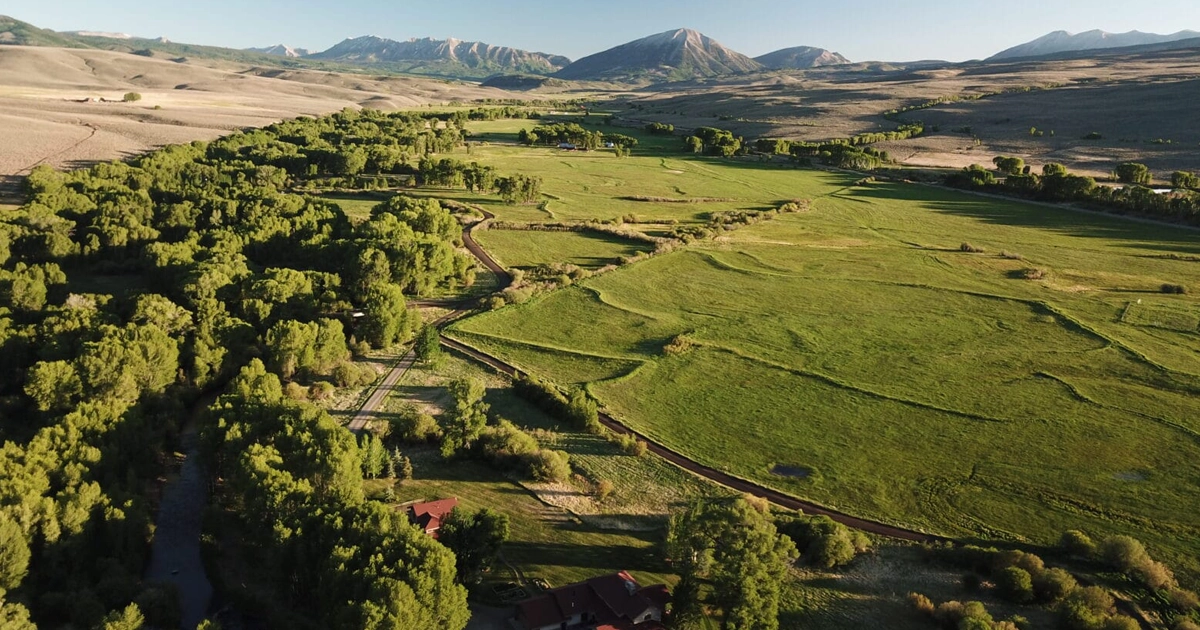
Three and a half miles of the Yellowstone River course through this 5,500-acre ranch, which features stunning views of the Absaroka, Beartooth, and Crazy Mountain ranges. A Yellowstone Valley gem, the Engwis features 900 irrigated acres, all mineral rights, significant water rights, and a 9,500 S.F. main residence. A newly constructed indoor riding arena also includes an attached guest house.

$15.5 million
(970) 769-8989
www.engwisranch.com

Market Watch: Chicago Fed Cites Surge in Midwest Land Prices

 Farmland

Agricultural land values in the Seventh Federal Reserve District jumped 12% in 2010, according to the Federal Reserve Bank of Chicago. The district encompasses key portions of America’s Corn Belt, including Illinois, Indiana, Iowa, Michigan, and Wisconsin. The increase was the second largest on record over the last three decades and was greatest in Iowa, where values soared a whopping 18 percent.

According to the Chicago Fed’s newsletter, “Slightly more than half of the respondents expected farmland values to keep rising during the January through March period of 2011.”

Read the Chicago Fed’s AgLetter HERE.

FOUR TIMES A YEAR
gricultural land values in the Seventh Federal
Reserve District jumped 12 percent in 2010,
according to the Federal Reserve Bank of Chicago.
The district encompasses key portions of America’s
Corn Belt, including Illinois, Indiana, Iowa, Michigan, and Wisconsin. The
increase was the second largest on record over the last three decades and
was greatest in Iowa, where values soared a whopping 18 percent. According
to the Chicago Fed’s agricultural newsletter, “Slightly more than half of the
respondents expected farmland values to keep rising during the January
through March period of 2011.” Read the Chicago Fed’s AgLetter HERE.VAL

For Sale: Colorado’s Dallenbach Ranch

For Sale: Colorado's Dallenbach Ranch

Spring 2011 Pricing Update: Colorado’s 130-acre Dallenbach Ranch now offered for $21 million.

The year was 1973, and Wally Dallenbach’s racing career had shifted into high gear. Thanks to back-to-back-to-back wins for Patrick Racing on the Indy car circuit, he had the opportunity to fulfill his dream of buying a piece of property in Colorado. And as Peppy Dallenbach points out, it was definitely her husband’s dream, not hers. “I was perfectly happy back home in New Brunswick where our families lived,” she says.

Years before, however, Wally had promised himself that he and Peppy would make the Rocky Mountains their home. The seed had been planted in 1960 on their honeymoon when the couple made a stop in Aspen. “It was all hippies and dogs back then,” Wally says. The New Jersey native was already making a name for himself as a drag racer and a stock car racer; his open cockpit racing days were still to come. But already he knew that he had fallen for the small-town charm and scenic beauty that can be found a short drive down just about every road that crisscrosses the Colorado Rockies.

It would take more than a decade to fulfill that promise, but he finally closed on a beautiful old homestead just outside of Basalt in 1974. Thanks to more than half a mile of frontage on both sides of the Frying Pan River, a dozen cabins dotted its 100-plus acres. Known to anglers as the Wooden Handle, the breathtaking encampment had also served as base camp for hikers and hunters who roamed the millions of acres of the White River National Forest bordering the property.

“Growing up on the ranch was like growing up in Disney World,” says Wally Dallenbach Jr. Like his father and his brother, he pursued a career in racing, and his training ground was the mountains and valleys surround his family’s ranch.

“We rode dirt bikes in the summertime. We rode snowmobiles in the winter time. There was everything a kid could want to do. It was a great place for my sister and brother and I to grow up,” he says.

In the 1970s, Basalt was nowhere near the cosmopolitan getaway is has since become. Paul Dallenbach recalls “a whopping 400 people” living there when the family first arrived, and going to Basalt High School had nowhere near the cachet of archrival Aspen High School. “That’s all right,” he says. “We beat them in every sport they played.”

Like many overachievers, Wally brought his work home. In his case, it took the form of a Honda 350. One summer day, he loaded Wally Jr. on the back of that dirt bike, and the two took off for a great old mining town called Ouray. The next day father and son went over Engineer Pass to Lake City. If this sounds like too much fun, now you know where the Colorado 500 got its start. Since 1976, the charity ride has raised more than $1 million for the Red Cross, area schools, churches, and hospitals, and countless other beneficiaries. A Who’s Who in racing has showed up to ride, including Parnelli Jones, Rick Mears, Roger Mears, Roger Penske, a whole host of Unsers, and of course all the Dallenbachs.

A disappointing number of sports stars plow their money into poor investments. Not Wally Dallenbach. In the early 1970s, the legendary Indy car racer took his winnings from the California 500 and bought an absolutely stunning piece of property along the banks of Colorado’s Frying Pan River just outside Basalt. In the 35 years since then, Wally and his wife, Peppy, not only raised a family but they also bettered the lives of thousands of Coloradoans through their own amazing race, the Colorado 500.

After 180 Indy car races, Wally’s career behind the wheel took a sharp turn; for the next 23 years he would serve as CART’s chief steward. Since his retirement in 2003, he and Peppy spend as much time as possible following the fortunes of their grandchildren. Although Paul and his wife, Dana, are right next door in Basalt, Wally Jr.’s family is in Texas and Colleen’s is in Indianapolis. Convenient airport connections have become a top priority.

With that in mind, the Dallenbachs decided to sell the ranch. Mark Weida, a suspension specialist who has worked on racing cars for 30 years, introduced the couple to Chip Lenihan, a great wit who proudly describes himself as “the last Republican mayor of Telluride.” In addition to being a longtime ranch broker, Lenihan had another equally important qualification. He is an avid fly-fisherman.

The Fay Ranches broker sees enormous upside. “The right investor can acquire this incredible piece of property and then recoup a substantial percentage of the purchase price with a conservation easement,” he says.

Another big plus is the ranch’s Eagle County setting.  “You’re right next door to Pitkin County, which is probably the most restrictive county in the Colorado. Everything from subdivision to structure size is strictly controlled through the county planning process. Eagle County also has a comprehensive planning department, but it is much more private property rights-oriented and much more smart growth-oriented,” he says.

One final attribute stands out. Says Lenihan, “It’s the lower part of the Frying Pan, so you’ve actually got a mix of trout that migrate up from the Roaring Fork. There are all sorts of little shallows and ripples, and there’s one deep pool that’s always good for a 20-incher.”

Try putting a price on that.

Take a tour of this one-of-a-kind property HERE.

Land Report March 2011 Newsletter

March 1, 2011 by  
Filed under Feature, Newsletter

Land Report March 2011 Newsletter

Take a look at this month’s edition of The Land Report newsletter, and you’ll see a wide array of opportunities to invest in land. From the pastoral – Virginia’s horse country – to the nitty gritty – Fayetteville shale gas interests – and of course the time-tested returns of Midwest farmland, land’s appeal as a tangible commodity continues to rise. No doubt this trend will only strengthen thanks to John Malone’s January purchase of more than 1 million acres, primarily in Maine but also in New Hampshire, the biggest transaction in decades.

For more up to the minute reports, follow The Magazine of the American Landowner on Facebook and Twitter.

P.S. Our award-winning quarterly magazine is available in a print version via subscription.

« Previous PageNext Page »