

Land Report 100
Who is America’s
Largest Landowner?
This question is the quest of the Land Report 100 Research Team all year long.
In 2026, America’s largest private landowner is Stan Kroenke, who controls an estimated 2,700,000 acres nationwide. In December, Kroenke cemented his position at the top of the rankings by completing the single-largest land purchase in the United States in more than a decade—acquiring more than 937,000 deeded acres of ranchland in New Mexico from the heirs of Teledyne founder Henry Singleton (1916–1999).
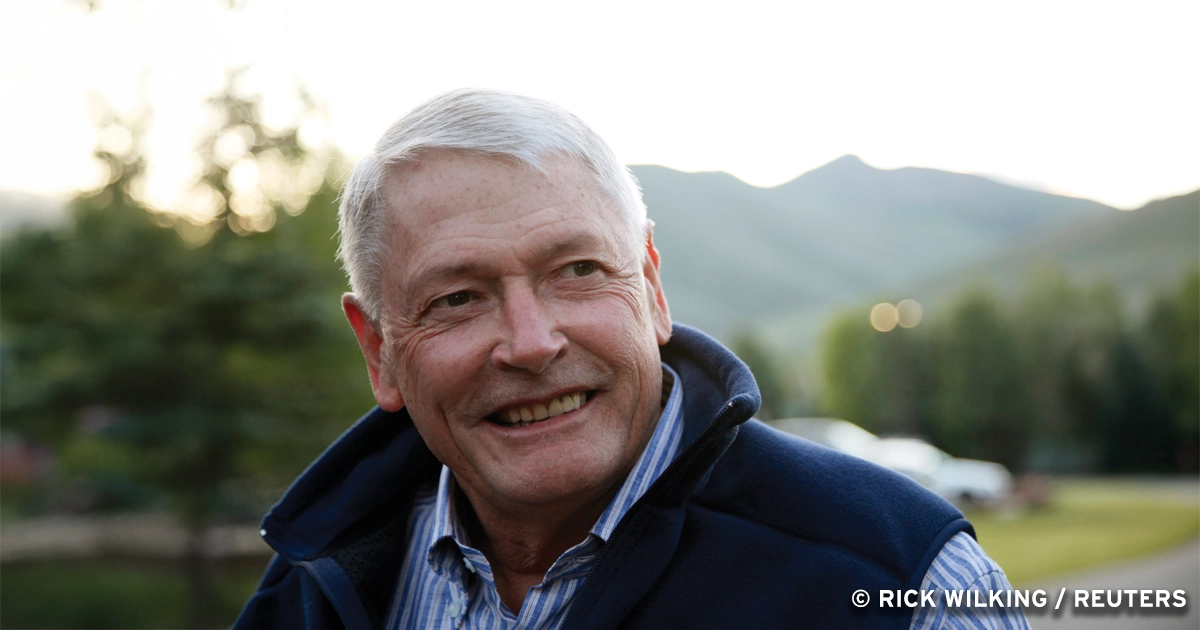
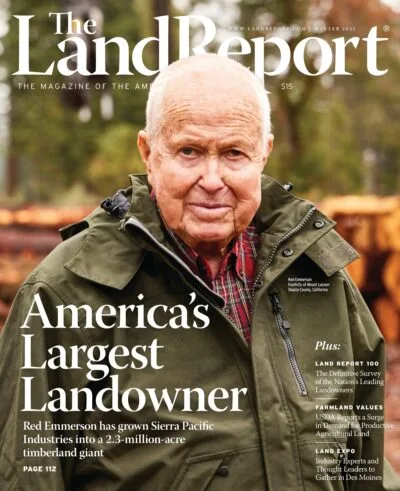
Kroenke is followed by Red Emmerson and his family, who rank second with 2,440,000 acres in California, Oregon, and Washington through their timber-products company, Sierra Pacific Industries. The Emmersons vaulted into the top tier of American landownership in 2021 after purchasing 175,000 acres in Oregon from Seneca Timber Company, a move that pushed them past Liberty Media chairman John Malone, now the nation’s third-largest landowner with 2,200,000 acres.
Rounding out the upper ranks is CNN founder Ted Turner, who stands fourth with 2 million acres spanning the Southeast, the Great Plains, and the American West.
The Land Report 100 Research Team analyzes transactions and scours records to determine America’s leading landowners. That’s how we broke the news in 2020 that Microsoft co-founder Bill Gates was America’s largest farmland owner with more than 260,000 acres. That’s how we identified Shanda Investment Group founder Tianqiao Chen as the owner of almost 200,000 acres of Oregon timberland in 2024. It’s one of the many reasons why news organizations worldwide rely on the Magazine of the American Landowner to understand this asset class.
Top 100
Landowner List
Since 2007, this survey of America’s leading landowners has been the gold standard for private land ownership. Each year we proudly host the reveal of the latest edition of the list at the Land Investment Expo in Des Moines, Iowa, and we look forward to highlighting these landowners all year long as the presenting sponsor of The Land Report 100.
| RANK | NAME | TOTAL ACRES | ABOUT | 2026 UPDATE |
|---|---|---|---|---|
| 1. | 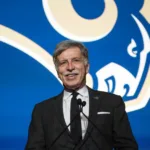 Stan Kroenke | 2,700,000 | View profile | STAN KROENKE IS AMERICA’S LARGEST PRIVATE landowner. In December, Kroenke completed the single-largest land purchase in the US in more than a decade — more than 937,000 deeded acres of ranchland in New Mexico belonging to the heirs of Teledyne founder Henry Singleton (1916-1999). |
| 2. |
| 2,440,000 | View profile | THE LARGEST PRIVATE TIMBERLAND OWNER in the nation, the Emmersons’ Sierra Pacific Industries (SPI) has long been recognized as one of America’s leading forest-products companies. |
| 3. |  John Malone | 2,200,000 | View profile | A joint project between the Malone Family Land Preservation Foundation and The Land Institute, the PERENNIAL AGRICULTURE PROJECT is dedicated to science-based research and developing food-production methods that sustain both land and soil. |
| 4. | 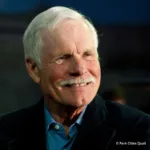 Ted Turner | 2,000,000 | View profile | SEASON OF SABBATICAL debuts in January at Vermejo, the crown jewel of Ted Turner Reserves. Voted the World’s Best Resort Hotel in the West by readers of Travel + Leisure magazine, the his-toric 558,000-acre ranch in Northern New Mexico and Southern Colorado offers an array of experiences, includ-ing alpine tundra, 19 fishable lakes, and a herd of bison 1,200 strong. |
| 5. |  Reed Family | 1,615,000 | View profile | A TWO-DECADE EFFORT to restore ancestral land along the Klamath River culminated in May with the transfer of 47,097 acres belonging to the Reeds’ Green Diamond Resource Company, a move that more than doubled the land holdings of Northern California’s Yurok Tribe. |
| 6. |  Buck Family | 1,320,000 | View profile | A native of South Portland, Maine, PETER BUCK (1930—2021) was the first member of his family to go to college. He excelled in the sciences at Bowdoin College — Class of 1952 — and earned advanced degrees in physics at Columbia University, where he studied under Charles Townes, inventor of the laser, and completed his doctoral dissertation under Nobel Prize winner Isidor Isaac Rabi. |
| 7. |  Irving Family | 1,267,000 | View profile | Through IRVING WOODLANDS, the family owns 3.2 million acres in Maine and in New Brunswick and Nova Scotia, Canada. Irving Woodlands manages 2.6 million acres of government-owned Crown lands in New Brunswick under a 25-year evergreen-forest-management-and-wood-supply agreement. |
| 8. |  King Ranch Heirs | 911,000 | View profile | Created and endowed in 2003 by members of the King Ranch family to commemorate the 150th anniversary of the founding of King Ranch, the KING RANCH INSTITUTE FOR RANCH MANAGEMENT (KRIRM) at Texas A&M University – Kingsville focuses on educating the next generation of ranch managers. |
| 9. |  Pingree Heirs | 830,000 | View profile | David Pingree Sr. (1795–1863) enjoyed such enormous success in shipping that he was labeled “The Merchant Prince of Salem” in his day. Pingree sensed the demise of seafaring Salem, and he pursued a second career as a land baron. He acquired extensive holdings in New Hampshire, including much of Mount Washington, and in Maine, where his fifth-, sixth-, and seventh-generation heirs manage their timberlands via Bangor-based SEVEN ISLANDS LAND COMPANY. |
| 10. |  Cullen Heirs | 800,000 |
Hugh Roy Cullen (1881-1957) was born in North Texas but made his fortune in Houston. His initial success came from identifying salt domes in and around Harris County and then targeting the oil-rich sands below. Grandson Corbin Robertson Jr. transitioned the family away from oil and gas and into coal. Robertson oversees a portfolio of more than 13 million acres of mineral interests and subsurface rights at Quintana Minerals Corporation.
| |
| 11. | Briscoe Family | 738,000 | Andrew Briscoe (1810-1849) was a pioneering Texan who signed the Texas Declaration of Independence and fought at the Battle of San Jacinto. His descendants’ BRISCOE RANCH COMPANY got its start with Dolph Briscoe Sr. (1890–1954). Two-term Texas Governor Dolph Briscoe Jr. (1923–2010) grew the family’s holdings to the point that he ultimately ranked as the largest single landowner in the Lone Star State. Today, the Briscoes’ holdings are run by Dolph “Chip” Briscoe III and encompass more than 1,000 square miles. They range from the 100,000-acre Catarina Ranch in South Texas to a portion of the historic Matador Ranch 500 miles due north in the Texas Panhandle. | |
| 12. | Wilks Brothers | 652,000 | The sons of a Texas bricklayer, Dan and Farris Wilks started a fracking-equipment business in their hometown of Cisco at the very moment the Barnett Shale was about to be transformed into the epicenter of energy exploration. A decade later, they sold their 70 percent interest in FRAC TECH for $3.5 billion and invested in ranchland in Idaho, Montana, and Oregon. In August 2025, they sold their Anchor Ranch to the American Prairie Foundation. No financial details were revealed. According to the foundation, the Anchor totals 67,960 acres, including 22,837 acres of deeded land and 45,123 leased acres, making it the second-largest land purchase in the nonprofit’s 24-year history. | |
| 13. | Thomas Peterffy | 647,000 | The founder and largest shareholder of Interactive Brokers, this Hungarian immigrant joined the Land Report 100 in 2015 after paying more than $700 million to acquire one of the largest timber tracts in the Southeast: the 561,000-acre FOLEY TIMBER & LAND COMPANY. Located between Tallahassee and Gainesville, Florida, Foley Timber & Land was described as the “largest contiguous parcel of undeveloped private land east of the Mississippi River” by David Gelles of The New York Times when it was listed. Peterffy has purchased additional acreage in Florida and has a considerable agricultural operation on the Great Plains. | |
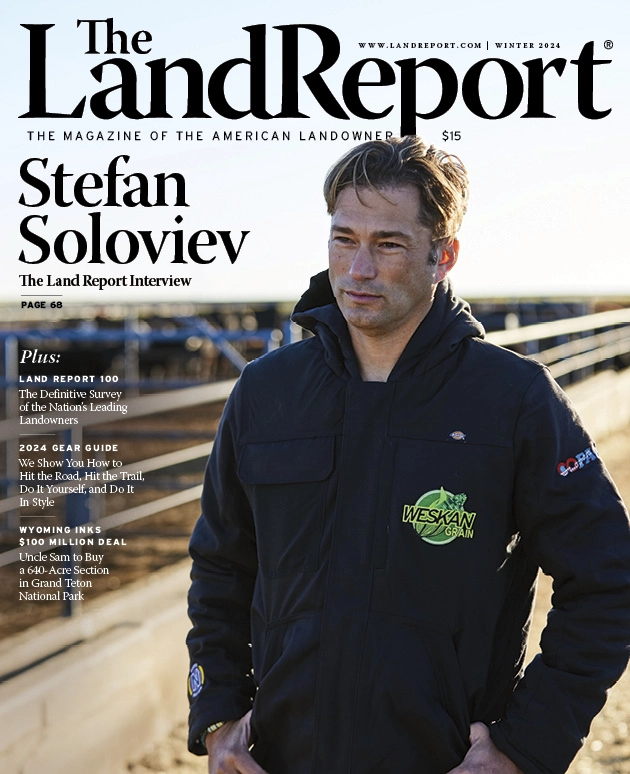
| 14. | Stefan Soloviev | 629,000 | Soloviev announced significant growth across his Colorado shortline railroads and agricultural operations, reinforcing his commitment to strengthen transportation infrastructure and support High Plains producers. His shortline rail network, which primarily transports agricultural commodities, has expanded to move grain and potatoes to Texas Gulf Coast export markets. Soloviev’s WESKAN GRAIN doubled its commercial grain-storage capacity to 12 million bushels in 2025. This expansion is enabling farmers in Western Kansas and Eastern Colorado to improve profit margins through enhanced access to both Union Pacific and BNSF, as well as letting them load high-efficiency shuttle unit trains. | |
| 15. | Brad Kelley | 624,000 | The sale of Kelley’s DAWSON ELK VALLEY RANCH in Northern New Mexico to The Nature Conservancy closed on December 15. The multiyear effort on the part of listing brokers Jeff Hubbard and Pat Lancaster of Mirr Ranch Group benefitted from the matchless setting adjacent to Ted Turner’s Vermejo. | |
| 16. | Lykes Heirs | 615,000 | A deer hunter on the family’s 272,000-acre O2 RANCH in Far West Texas picked up the trail of far bigger game when he discovered what turned out to be an ancient mammoth tusk in a dry creek bed. The discovery, which was verified by a team of researchers under the auspices of the Center for Big Bend Studies (CBBS) at Sul Ross State University in Alpine, Texas, was announced on March 11. | |
| 17. | Ford Family | 600,000 | In 1936, Kenneth Ford (1908–1997) created ROSEBURG FOREST PRODUCTS with a single sawmill made with salvaged parts. In the 1940s, he began assembling a timberland portfolio by acquiring properties that had been repossessed for nonpayment of taxes. Ford purchased Kimberly-Clark’s California timberlands in 1979 and International Paper’s Oregon timberlands in 1996. Roseburg owns and manages 400,000 acres of Douglas fir timberland in Oregon and nearly 200,000 acres of loblolly pine forests in North Carolina and Virginia. | |
| 18. | Westervelt Heirs | 600,000 | WESTERVELT COMPANY officials like to say that their focus is on quarter-centuries, not quarterly financial reports. That mindset, which is focused on a long-term approach, has helped the Alabama-based land-management company stay in business for more than 140 years and expand its forestland holdings to more than 600,000 acres across six states. In addition to ensuring that its timberlands meet the certification standards established by the Sustainable Forestry Initiative and the Forest Stewardship Council, Westervelt also provides more than 100,000 acres of wildlife-management assistance to private landowners and helps preserve 40,000 acres of wetland and endangered-species habitat through its Ecological Services Division. | |
| 19. | Stimson Family | 552,000 | The sixth-generation descendants of Thomas Douglas “T.D.” Stimson (1827–1898) own one of America’s oldest continuously operating integrated-wood-products companies. In the 1880s, Stimson sold his Great Lakes forests and moved to the Pacific Northwest. Today, STIMSON LUMBER COMPANY operates seven mills in Oregon and Idaho and owns significant fir, pine, and cedar operations in Oregon, Idaho, and Montana. | |
| 20. | Martin Family | 550,000 | ROYOMARTIN was founded by Roy O. Martin Sr. in 1923 and supplied much of the Southern yellow pine used in the construction of the famed Higgins Boat that was utilized by Allied forces in amphibious landings in many theaters. Today, the company owns and operates more than 550,000 acres of Forest Stewardship Council-certified timberland and three of the largest wood-panel plants in North America. | |
| 21. |  Jeff Bezos | 462,000 | View profile | Amazon’s founder and executive chair continues to use his ranchlands in Far West Texas to explore the fringes of the final frontier. For the past decade, Bezos and his BLUE ORIGIN aerospace company have been launching rockets and people from Launch Site One, approximately 120 miles east of El Paso, north of the Texas town of Van Horn. The company’s 37th mission with its reusable New Shepard rocket system took place in December. |
| 22. | Zane & Tanya Kiehne | 455,000 | The respected ranching couple added nearly 41,000 acres in New Mexico’s Mora County to their UU BAR RANCH, which they bought from Bob Funk. Under their ownership, the UU Bar has grown from 160,000 acres to more than 283,000 acres, a figure that also includes a small state lease. UU Bar’s grassland prairies, mesas, and varied forests are home to elk, mule deer, whitetail deer, antelope, turkey, grouse, black bear, mountain lion, and other game. | |
| 23. | Shannon Kizer | 445,000 | Although the majority of his extensive landholdings can be found west of the 100th meridian in the arid Southwest, Kizer clearly has a soft spot for well-watered ground in the Sooner State. In December, he closed on MIDDLE CREEK RANCH, which had been stewarded by the Lorton family, longtime owners of the Tulsa World. Kizer’s new 14,000-acre cattle operation wraps around a bend of the Canadian River in Hughes and McIntosh Counties. | |
| 24. | Simplot Family | 443,000 | The family-owned J.R. Simplot Company has extensive cattle ranching and phosphate-mining interests and grows more than a dozen crops on 82,500 acres of farmland in the US. Worldwide, Simplot employs 13,000 people in more than 60 countries. Founded by JACK SIMPLOT (1909–2008), the company pioneered the frozen french fry. Simplot’s biggest customer? His close friend Ray Kroc of McDonald’s fame. | |
| 25. | Fisher Family | 440,000 | The founders of THE GAP, the Fishers invested in California timberland. They created the Mendocino Redwood Company in 1998 and the Humboldt Redwood Company in 2008 to manage coast redwood and Douglas fir timberlands in Northern California’s Sonoma, Mendocino, and Humboldt Counties. All of the family’s forest-management practices are subject to Forest Stewardship Council standards for certification. | |
| 26. | Kenedy Ranch | 425,000 | A Pennsylvania Quaker by birth, MIFFLIN KENEDY (1818–1895) clerked on a steamer as a teenager, worked his way up the ladder, and eventually became a steamboat captain and owner. He subsequently formed a lucrative partnership with a fellow riverboat pilot, Richard King (see No. 9 King Ranch Heirs). Yet the extensive Kenedy clan suffered from a curious malady: no heirs. The death of his granddaughter, Sarita Kenedy East (1889–1961), precipitated an avalanche of legal wrangling. The great ranch is now owned by the John G. and Marie Stella Kenedy Memorial Foundation and the John G. Kenedy Jr. Charitable Trust. | |
| 27. | O'Connor Heirs | 410,000 | In a landmark partnership with The Nature Conservancy, the Gulf Coast Ecosystem Restoration Council (RESTORE Council) and the Texas Commission on Environmental Quality, 6,410 acres of the T.M. O’CONNOR RANCH was placed under a conservation easement in October. A $7.6 million grant administered by TCEQ via the RESTORE Council helped fund the $8.863 million easement. The Knobloch Family Foundation, Frank Klein, and H-E-B made additional contributions in support of the largest remaining coastal prairie habitat in Texas. | |
| 28. | Skiles Family | 403,000 | Clifford Skiles Jr. (1944-2025) died in February. Born in Plano, Texas, he attended TEXAS A&M UNIVERSITY and became a DVM. Skiles built a vertically integrated agribusiness, including a grain-processing business and cattle-feeding operation. | |
| 29. | Holding Family | 395,000 | Carol Holding, who worked alongside her husband, Robert Earl Holding, and turned a convenience store into an oil-and-gas empire, died on December 23, 2024, at 95. Throughout their 64-year marriage, the Holdings intertwined the personal with the professional, starting with a 25-acre peach, pear, and apple orchard in Dimple Dell, Utah. In 1977, they purchased Idaho’s SUN VALLEY RESORT. Carol took a special interest in the Sun Valley Lodge and remodeled it several times. | |
| 30. | Bass Family | 381,000 | In 2017, the four great-nephews of legendary wildcatter SID RICHARDSON (1891–1959) sold the family’s legacy energy interests in the highly sought after Permian Basin to ExxonMobil for $6.6 billion. The purchase nearly doubled the ExxonMobil’s resources in the Permian. On the Great Plains, the Bass family ranks as the largest landowner in Kansas with 110,000 acres. | |
| 31. | Robinson & Freed | 373,000 | In 2025, the Salt Lake City-based Ensign Group added five deeded units in Idaho’s Pioneer Mountains. The strategic acquisition, which has been christened ENSIGN PIONEER RANCHES, includes 23,000 acres of deeded land and more than 300,000 acres of US Forest Service and BLM grazing permits, state of Idaho grazing leases, and private leases. The property’s new owners will enjoy world-class wildlife and spectacular trout waters. | |
| 32. | Collins Family | 370,000 | Collins has replanted 15,000 acres of ground scorched in the COUGAR PEAK and DIXIE FIRES and is on track to complete the remaining 35,000 acres by the end of the decade. It’s also working to execute more than 11,000 acres of post-fire restoration in the Fremont-Winema National Forest. To replenish seed stock and support restoration efforts, they collected 2,500 bushels of pine cones last year on their properties. | |
| 33. | Mike Smith | 351,000 | Although he owns ranchland in New Mexico, the vast majority of Smith’s 351,000 acres are located in the Lone Star State. Smith learned about the cattle industry from the legendary Paul Engler at CACTUS FEEDERS in Amarillo, Texas. Engler was building his feed operation into the world’s largest and proved to be an able mentor to Smith, who not only established his own feed yard but launched a commodity-trading firm. | |
| 34. | Malone Mitchell 3rd | 349,000 | Oklahoma State alumni Malone and Amy Mitchell founded RIATA ENERGY in their guest bedroom with $500 in start-up capital. Two decades later, they sold their interest in Riata to Chesapeake Energy co-founder Tom Ward for $500 million. The Mitchells established their Longfellow Ranches as one of the finest hunting properties in Texas’s Trans-Pecos region. A full-service, 4,700-square-foot lodge welcomes guests. | |
| 35. | Killam Family | 341,000 | Third- and fourth-generation descendants of O.W. KILLAM (1874-1959) own significant ranchlands in Kansas, Nebraska, Oregon, and New Mexico. But their South Texas holdings — the 125,000- acre Duval County Ranch included — dwarf the rest of their portfolio. In 2024, the family listed the 6,041-acre O|W Ranch near Corpus Christi, Texas, for $30 million. Jay Leyendecker of Hall and Hall has the $29.95 million listing, which includes six homes, 23 ponds, and nearly 800 acres of farmland. | |
| 36. | Barta Family | 340,000 | Headquartered in Fremont, Nebraska, Barta Cattle Company owns and operates additional acreage in Nevada and Oregon. The family fortune can be attributed to Jim Barta (1942–2019), a pharmacist who pioneered the concept of establishing operations within retail and grocery store settings. Barta’s single pharmacy eventually became the national drugstore chain SAV-RX. | |
| 37. | Hughes Family | 319,000 | DAN ALLEN HUGHES SR. (1929–2016) earned a geology degree from Texas A&M University. He went on to find, finance, and drill his own wells. DAN ALLEN HUGHES JR. now runs the family’s oil firm, DAHCO, which has discovered and produced oil and gas throughout Texas, Louisiana, Mississippi, Alabama, Florida, and the Rockies. | |
| 38. | Horton Family | 302,000 | The sale of New Mexico’s GREAT WESTERN RANCH in 2025 trimmed more than 350 square miles off the family’s deeded-acreage total. Acquired in 2014 by family patriarch DON HORTON (1950–2024), the Great Western was listed with Jeff Buerger at Hall and Hall for $115 million. | |
| 39. | Cogdell Family | 284,000 | David Munsey “D.M.” Cogdell Sr. (1884-1964) considered himself to be an “old-time horse trader.” He was also an accomplished land trader. His TULE RANCH formed the basis for a diverse series of enterprises run by different descendants that include beef cattle, oil and gas, and award-winning Quarter Horses. | |
| 40. | Fasken Family | 284,000 | In 1913, a Canadian attorney named David Fasken paid $1.50 per acre for hundreds of thousands of arid acres in the Permian Basin of West Texas. Today, FASKEN OIL AND RANCH monetizes those valuable holdings in the heart of the most productive oil-and-gas field in the nation. Fasken Oil and Ranch also owns three significant South Texas ranches. | |
| 41. | Llano Partners | 284,000 | In 1995, Louisiana native Hughes Abell sold his interest in a family business and moved to Texas. A quarter-century later, the enterprising rancher became the president of the Texas & Southwestern Cattle Raisers Association. Through LLANO PARTNERS WILDLIFE, the Abells book hunts on family properties in Northeastern New Mexico, the Texas Panhandle, and South Central Florida. | |
| 42. | Benjy Griffith III | 279,000 | Griffith founded SOUTHERN PINE PLANTATIONS in 1984. Based in Macon, Georgia, the company develops and implements strategies to monetize timberland, farmland, and other income-producing properties. Through his companies and his heirs, Griffith owns land in Alabama, Arkansas, Florida, Georgia, Montana, South Carolina, and Texas. | |
| 42. | Kokernot Heirs | 278,000 | The family’s o6 brand was first registered in 1837 when Texas was a republic, not a state. John Kokernot acquired the historic brand in 1872, and he and his brother, Lee, began running cattle west of the Pecos River. In 1912, Lee’s son Herbert Lee Sr. (1867–1949) started assembling the ranches known today as the O6 RANCH and the LEONCITA CATTLE COMPANY. | |
| 44. |  Bill Gates | 275,000 | View profile | THE PLAN for the creation of what Bill Gates calls “the most advanced nuclear facility in the world” is nearing critical-ity. TerraPower, which Gates founded, has endeavored to establish a next-generation, sodium-cooled reactor on 44 acres in Kemmerer, Wyoming. The project cleared a major hurdle in December when the Nuclear Regulatory Commission (NRC) announced that it had completed an evaluation of the project and found “no safety aspects that would preclude issuing the construction permit.” |
| 45. | Babbitt Heirs | 275,000 | Babbitt Ranches, which dates from 1886, partnered with NextEra Energy Resources, Coconino County, and the Arizona State Land Department to generate wind power via 50 turbines. “Each of us brings a unique part to the table — our skills, our expertise, our willingness to make tough decisions,” said BABBITT RANCHES President Billy Cordasco at the new Babbitt Ranch Energy Center. “And while those contributions are important on their own, together they create something greater: a future where we not only generate energy but also foster hope, resilience, and a connection to the land and each other.” The project will generate 161 megawatts of electricity. | |
| 46. | Jones Family | 275,000 | At the tail end of the 19th century, William Whitby Jones (1858-1942) ponied up $10,000 for 20,000 acres in Texas’s Starr County. Today, the seventh-generation descendants oversee an array of interests on the 34,000-acre ALTA VISTA RANCH near Corpus Christi. W.W.’s great-great-great-granddaughter Anna Avery assists her father in running the diverse property. | |
| 47. | Lee Family | 275,000 | Floyd Lee (1895–1987) signed on as a bronc rider on the FERNANDEZ RANCH in Western New Mexico in 1919. The World War I veteran climbed the ranks and eventually became ranch manager of the historic holding. In 1939, he and his wife, Frances, became the ranch’s owners. | |
| 48. | True Family | 272,000 | Sprawling across a wide swath of Eastern Wyoming, TRUE RANCHES is comprised of eight ranches, two farms, and a feedlot. The fully integrated agribusiness grew out of David and Jean True’s 1957 purchase of the Double Four Ranch in Wyoming’s Albany County. On an annual basis, True Ranches produces around 7,500 calves. | |
| 49. | 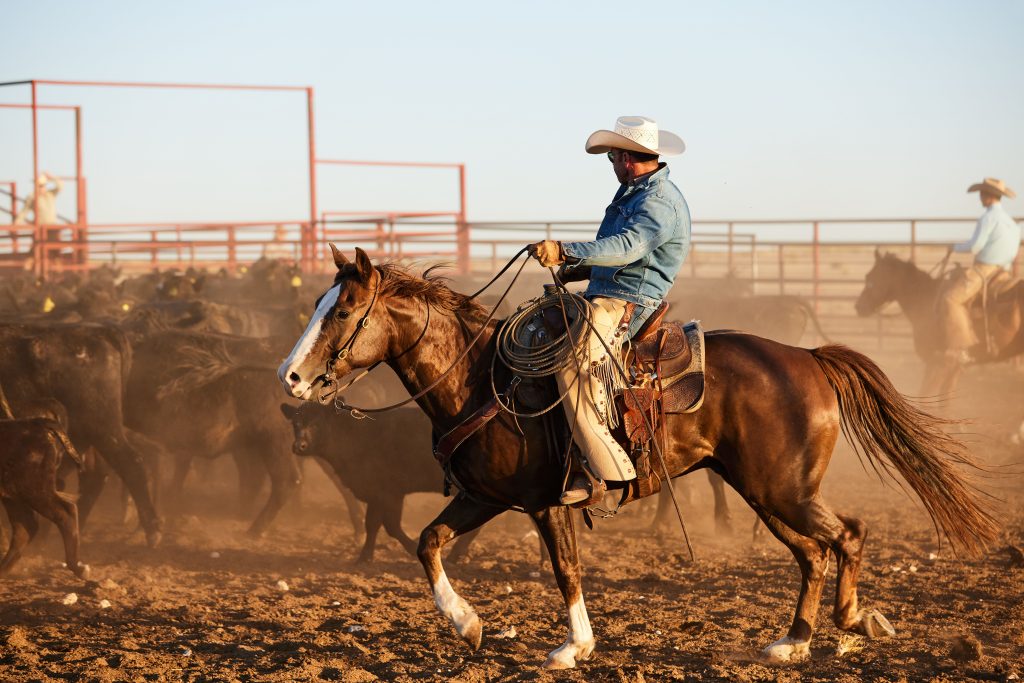 Taylor Sheridan | 267,000 | View profile | In May, the entertainment icon and owner of the legendary FOUR SIXES RANCH took center stage as he received honorary degrees from two Texas universities and addressed a third. In Fort Worth, Sheridan was awarded an honorary doctor of letters from Texas Christian University (TCU). In announcing the news, TCU Chancellor Victor Boschini and TCU President Daniel Pullin cited Sheridan’s “artistic achievements as a writer, director, and producer.” Students, staff, and the picturesque Southwestern campus have all been featured on Sheridan’s hit streaming series Landman on Paramount+. |
| 50. | Galt Family | 262,000 | The history of the Montana Territory is intertwined with this family’s story. WELLINGTON D. RANKIN (1884–1966) served as Montana’s attorney general, was appointed to the state supreme court, and reportedly ranked as the state’s largest private landowner. His sister JEANNETTE RANKIN (1880–1973) was the first woman to hold federal office in American history. | |
| 51. | Hadley Family | 260,000 | In 1990, The Nature Conservancy paid Pablo Brenner $18 million for the historic GRAY RANCH in the bootheel of New Mexico (pictured below). After inventorying it and placing it under a conservation easement, the conservancy sold it to Drummond Hadley’s Animas Foundation in 1994. In addition to its deeded acres, the ranch benefits from a substantial leased component. | |
| 52. | Sanders Family | 256,000 | In 1992, Bob and Jane Sanders and Rob and Carla Sanders acquired ROARING SPRINGS RANCH in Southeast Oregon. The family runs it as a cow/calf-stocker operation with more than 6,000 cow/calves and 150 horses. The combined holdings total more than 1 million acres of deeded land and BLM grazing allotments in the high-desert country outside Frenchglen. | |
| 53. | Miller Family | 255,000 | The T.R. MILLER MILL COMPANY celebrated its 150th anniversary in 2022. One of the largest softwood lumber producers in the nation, T.R. Miller also manufactures specialty pine products, including pine flooring, siding, and pattern products. Holdings include CEDAR CREEK LAND & TIMBER (162,000 acres), TRM WOODLANDS (53,000 acres), and NEAL LAND & TIMBER (39,600 acres). | |
| 54. | Kress Family | 250,000 | George and Marguerite Kress founded GREEN BAY PACKAGING in 1933. At the time, wooden boxes were used for shipping. The Kresses thought there might be a market for corrugated boxes. That bright idea has grown from one plant in Wisconsin to more than 40 facilities in 16 states, including timberland holdings near the company’s manufacturing plant in Morrilton, Arkansas. | |
| 55. | Coffee Family | 248,840 | Siblings Caren Coffee and Bill Coffee, whose forebears include Montana Rodeo Hall of Famer C.M. Coffee, own the COFFEE CATTLE COMPANY outside of Miles City, Montana, with additional properties in Custer and Rosebud Counties. Both siblings are active in the financial sector; Caren serves as executive vice president of Stockman Bank, while Bill serves as chairman and CEO. | |
| 56. | Langdale Family | 248,000 | Based in Valdosta, Georgia, the Langdale family of forest products includes more than a dozen companies and dates from its founding in the turpentine business in 1894 by JOHN LANGDALE. Today, the Langdale Company ranks as one of the largest private landowners in the Peach State. In 2022, the company planted its 130 millionth pine seedling. | |
| 57. | Angell Family | 244,000 | Based in Southeast New Mexico, DARR ANGELL and his son BILL ANGELL operate cattle ranches in Guadalupe, King, Lea, and Union Counties. They have also monetized land-based resources by selling water rights to exploration-and-production companies developing oil and gas fields in the greater Permian Basin. | |
| 58. | Riggs Family | 241,803 | Shortly after the conclusion of the Civil War, BRANNICK RIGGS (1828–1907) uprooted his young family, quit the Lone Star State, and headed west until he settled beneath the Chiricahua Mountains in Arizona’s Cochise County. At its peak, his Riggs Settlement included the largest single block of patented land in Arizona and was home to the Riggs Cattle Company. | |
| 59. | Hunt Family | 240,000 | Hunt Oil Company traces its rise to DAISY BRADFORD NO. 3, the first producing well in what became the largest field in the world. Although H.L. Hunt focused on the East Texas Oil Field, his son Ray and Ray’s family own and operate farms, ranches, and other landholdings in Arizona, Montana, New Mexico, Texas, Utah, and Wyoming via Hoodoo Land and Cattle. | |
| 60. | Hearst Family | 238,000 | The Hearsts’ landmark properties benefit organizations far beyond their fence lines. Since 1999, events on the SAN SIMEON property have raised more than $85 million for local, state, and national charitable. organizations. Two of the many fundraisers each year include “Share the Hope” for the Hearst Cancer Resource Center every April and the Hearst Castle Preservation Foundation benefit in September. In 2025, Hearst Ranch assisted with a fundraiser for several non-profits featuring Grammy Award winner Miranda Lambert, in collaboration with Hearst Castle and the Academy of Country Music. | |
| 61. | Brask Family | 230,000 | Conveniently located just minutes from Big Sky Resort, the family’s 320 GUEST RANCH in the Gallatin Valley was homesteaded in 1898 by Sam and Clinton Wilson, who each claimed 160 acres. In 1987, Dave Brask bought the historic guest ranch near Yellowstone National Park after a trip to the Treasure State. Two years later, he added an adjacent 160 acres. Today, the guest ranch features log homes and cabins, mountain chalets, a variety of dining options, and a full slate of outdoor activities. | |
| 62. | Gene Taylor | 230,000 | Taylor’s WARRIOR TRACTOR AND EQUIPMENT COMPANY has grown from a single dealership in 1967 to seven locations across the Southeast, with sales of $60 million annually. His love of the land dates to his youth. Taylor’s father worked for a timber-and-logging business in Alabama. During high school, he joined him on the job during summer vacations. Today, Taylor owns approximately 20,000 acres of the same timberland that he and his father once harvested. | |
| 63. | Fanjul Family | 229,592 | Six decades have passed since Cuban natives Alfonso and José “Pepe” Fanjul fled Fidel Castro’s regime and founded their Florida sugarcane operation in West Palm Beach. Today, the brothers’ FLORIDA CRYSTALS CORPORATION produces the only certified organic sugar that is grown, harvested, and milled in the US. They also produce a certified organic rice. | |
| 64. | Brophy Family | 228,000 | At its peak, the family’s Northern Arizona ranch encompassed 1 million acres, which were acquired from the Atlantic & Pacific Railroad. Founded in 1884, the family’s AZTEC LAND AND CATTLE COMPANY was laid out in the traditional checkerboard fashion of federal-government land grants. Aztec’s operating strategy has varied from running cattle to leasing pasturage to selling acreage. | |
| 65. | Bidegain Family | 225,000 | Established in 1902 by Yetta Kohn, the Bidegains run 2,500 mother cows on Eastern New Mexico’s T4 CATTLE COMPANY. Their holdings include the historic Mesa Rica, a 117,000-acre section that was carved off the renowned Bell Ranch in San Miguel County. The Bidegains acquired the Mesa Rica in 1947. | |
| 66. | Catron Cibola Ranches | 225,000 | The GREAT WESTERN RANCH was acquired by a Georgia-based LLC that invests in real estate assets. At 504,801 deeded and leased acres, the legacy property ranks as one of the largest single ranches in the nation. Jeff Buerger at Hall and Hall listed the $115 million Western New Mexico giant for the heirs of No. 38 Don Horton, and Dax Hayden of Hayden Outdoors represented the buyer. | |
| 67. | Sugg Family | 225,000 | The family’s O H TRIANGLE RANCH was established in 1898 by two brothers from Mississippi, J.D. and E.C. Sugg. The brothers’ fourth-generation descendants are based in Irion County near San Angelo, Texas. They raise grass-, hay-, and corn-fed beef, and they ship quarters, halves, and box beef nationwide via shopohtriangleranch.com. | |
| 68. | Lyda Family | 223,000 | In 1992, Gerald Lyda sold the 156,000-acre Ladder Ranch in South Central New Mexico to perennial Land Report 100er Ted Turner. Lyda subsequently relocated his cattle operation to LA ESCALERA RANCH in the Trans-Pecos region of Far West Texas. La Escalera is run with an emphasis on efficiency. Recent improvements have focused on water-distribution systems. Consistent brush control is another critical component of long-term productivity in the arid terrain. Angus are managed through Lyda Cattle Co. under the leadership of Gene Lyda, who was inducted into the Bull Riding Hall of Fame in 2024. Last year also marked the passing of Gene’s brother, Gerald “Dee” Lyda Jr., who devoted much of his later years to advancing water stewardship in the region. | |
| 69. | Bobby Patton & Mark Walter | 223,000 | Their Texas and New Mexico ranches aren’t the only investments that these two partners share. Through Guggenheim Baseball Management, Patton and Walter are co-owners of the LOS ANGELES DODGERS, the back-to-back World Series champions. Other partners in the franchise include Todd Boehly, Peter Guber, Magic Johnson, Stan Kasten, Billie Jean King, and Ilana Kloss. | |
| 70. | Bacon Family | 221,805 (208,376 Acres Under Conservation Easement) | Conservation philanthropist LOUIS BACON supports organizations across the country that are dedicated to protecting and restoring the natural world, with a focus on land conservation, healthy forests and watersheds, clean water, and environmental education. His efforts range from safeguarding groundwater and reducing wildfire risk in Colorado’s San Luis Valley to restoring longleaf pine and strengthening coastal resilience in North Carolina. | |
| 71. | Cassidy Heirs | 220,000 | One of Maine’s fabled lumber barons, JOHN CASSIDY (1842-1918) is likely the individual with the most astonishing backstory. At age 17, this Irish émigré walked to the Queen City — Bangor, Maine — from Nova Scotia. In the decades that followed, he snapped up forestland for as little as $2 an acre and eventually accumulated one of the greatest fortunes in the history of the Pine Tree State | |
| 72. | Scott Family | 220,000 | Homer and Mildred Scott started ranching in 1943 with 300 head on a 3,000-acre property. Each year, their family produces 10,000 feeder cattle on the 475,000-acre PADLOCK RANCH, which is headquartered along the Tongue River and straddles the Montana–Wyoming state line. A significant portion of the ranch’s leased lands lie on the 2.2-million-acre Crow Indian Reservation in Southern Montana. | |
| 73. | Kennedy Family | 219,663 | Peter Maximus Kennedy (1922–2009) was the chairman of Dominick & Dominick, one of Wall Street’s oldest continuously operated firms. He subsequently formed the family-owned Eighteen Seventy Corporation, an investment vehicle whose assets ranged from furniture manufacturers to private banks. Eighteen Seventy currently owns the GI RANCH in the shadow of the Ochoco National Forest, approximately 90 miles east of Bend, Oregon. | |
| 74. | Gabrych Family | 218,000 | The heirs of EUGENE GABRYCH (1924-2023) manage his sprawling interests in key California growth markets east of Los Angeles. The bulk of his land-based investments were in Imperial, Riverside, and San Bernardino Counties. | |
| 75. | Bridwell Heirs | 217,785 | A Missourian who moved to North Texas, Joseph Bridwell (1885–1966) discovered oil on the W.T. Waggoner Estate. His BRIDWELL OIL COMPANY ultimately produced 50 million barrels from more than 700 wells in Texas, Oklahoma, Colorado, Wyoming, Nebraska, and Montana. | |
| 76. | East Foundation | 217,000 | A leader in cattle ranching, wildlife conservation, science, and education, East Foundation’s six South Texas ranches are operated for efficient and sustainable beef production. Together they also serve as a living laboratory for research conducted in conjunction with university scientists — a collaboration that supports its designation as the nation’s first AGRICULTURAL RESEARCH ORGANIZATION. The foundation’s ranch management represents an outstanding example of conserving wildlife resources while maintaining agricultural productivity. East Foundation’s ranch managers and scientists train future leaders through ranch internships and engagement with university graduate programs. Its ranch-management team has developed high-quality cattle herds well-adapted to the challenges of South Texas. | |
| 77. | Gage Heirs | 213,730 | Elk, mule deer, aoudad, blue quail, and black bear make their home on land owned by the heirs of A.S. GAGE (1860-1928), who created one of the largest cattle operations in Texas history. His property stretches across the Chihuahuan Desert in the Trans-Pecos region near Big Bend National Park. Today, A.S. Gage Ranch is considered one of the premier hunting ranches in West Texas. | |
| 78. | Russell Gordy | 212,000 | This native Houstonian’s original 113-acre Piney Woods acreage has since grown to more than 8,000 acres. The oil-and-gas entrepreneur also owns the 48,000-acre DOUBLE ARROW RANCH on the Yellowstone River in Montana, an 80,000-acre ranch in Wyoming, and the 19,000-acre LA CENIZA in South Texas. | |
| 79. | Cunningham Sheep Co. | 211,563 | For more than a century, this Eastern Oregon family has supplied PENDLETON WOOLEN MILLS the wool that goes into their blankets and jackets. Founded by Charles Cunningham in 1863, the outfit was acquired in the 1930s by Mac Hoke. His descendants — the Coreys and the Levys — run registered Rambouillet. | |
| 80. | Reese Family | 208,238 | Homesteaded in the rolling hills of Eastern Wyoming in 1914, the ROCKIN’ 7 RANCH has a well-deserved reputation as a world-class outfitter specializing in mule deer, pronghorn, and bison. | |
| 81. | Boswell Family | 207,000 | Central California titan J.G. BOSWELL founded his eponymous company in 1925. Today, the ultra-private family focuses on tomatoes, controlling its homegrown supply from seed all the way through the processing plant. The Boswells rank as the largest producers of the most ubiquitous fruit in the world. The family farms also yield extra-long staple pima cotton, prized for its strength and sheen. | |
| 82. | Roger Burch | 203,000 | When pioneers began exploring the majestic forests of Northern California in the 1800s, they coined the term “Redwood Empire” to describe the large swaths of towering trees that towered over them. Roger Burch adopted that same phrase when he founded the Redwood Empire lumber company in 1971. Today, REDWOOD EMPIRE owns and manages hundreds of thousands of acres of timberland across Northern California. It also has access to 1.2 million acres of commercial, nonindustrial timberlands. Redwood Empire, which is a division of Pacific States Industries, grew substantially in 2015 when the company purchased nearly 30,000 acres of forestland in Mendocino and Sonoma Counties from the Edmunds family in a sale brokered by LandVest. | |
| 83. | Cocanougher Family | 202,000 | A former mayor of Justin, Texas, DANIEL COCANOUGHER is a serial entrepreneur who currently serves as chairman of THG Energy Solutions. In the fall of 2024, THG began working with the Tulsa Zoo to manage expenses and energy consumption. The nonprofit clawed back $50,000 in overpaid taxes as a result. | |
| 84. | Holland M. Ware Charitable Foundation | 200,000 | When a firefighter or other first responder rushes into a burning building, they take on the appearance of a real-life superhero. But as Brenda Thueson, executive director and trustee of the Holland M. Ware Charitable Foundation, points out, “That cape can burn.” So the Ware Foundation, which is funded by the timber business established by the late HOLLAND M. WARE, is responding to the needs of first responders through a charitable program with the First Responders Health Institute. | |
| 85. | Anthony Family | 200,000 | Founded in 1907 by Garland Anthony in South Arkansas, ANTHONY TIMBERLANDS is a multifaceted wood-products business and the largest independent owner of timberland in Arkansas. John Ed Anthony currently serves as chairman of the family-owned company. Operations include two pine sawmills, three hardwood sawmills, a hardwood-flooring plant, a wood-treating facility, and a hardwood-mat facility. | |
| 86. | Philip Anschutz | 198,000 | Denver-based Anschutz oversees a diverse portfolio that includes energy, minerals, real estate, railroads, telecom, hotels, festivals such as Coachella, and the NHL’s Los Angeles Kings. He remains committed to developing the Chokecherry and Sierra Madre Wind Energy Project on his OVERLAND TRAIL RANCH, which totals 320,000 acres near Rawlins, Wyoming. | |
| 87. | Tianqiao Chen | 198,000 | View profile | In 2015, the founder of Shanda Interactive Entertainment acquired nearly 200,000 acres of former Crown Pacific timberlands in Oregon from Fidelity National Financial Ventures for $85 million. Rebranded as the HIGH CASCADE TIMBERLAND PORTFOLIO, it is listed for $227 million with Robb Van Pelt of Mason Morse Ranch Company and Jake Polvi of Polvi Real Estate. |
| 88. | Stewart & Lynda Resnick | 196,775 | In September, Western Growers bestowed its 2025 Award of Honor on Stewart Resnick for his five decades of contributions to the agricultural community via THE WONDERFUL COMPANY. Resnick grew up in New Jersey in modest circumstances and attended UCLA, where he earned his bachelor’s and law degrees. In 1979, he bought 1,000 acres of Kern County farmland while acquiring Paramount Citrus. “I was going to be a passive investor, but I liked the opportunity — and the business — so I built it up,” he said. Resnick got cracking with the nut industry by entering the pistachio market. Today, Wonderful accounts for 60 percent of all pistachios sold in the US and 40 percent overseas. Forays into mandarins, seedless oranges, and pomegranates followed. All generated similar success. “Lynda was a genius with our branding, and I had a pretty good idea about sales and how to scale,” Resnick said. “I thought if we could apply that here, we could be a leader in this business and eventually dominate it,” he adds. Mission accomplished. | |
| 89. | Nunley Family | 191,500 | Richard and Bob Nunley carry on the tradition of running Santa Gertrudis cattle, which was established by their father, Texas cattleman RED NUNLEY. The brothers have expanded their operation from its Uvalde County roots to include ranches across the Lone Star State. | |
| 90. | Taylor Family | 191,000 | Based in Pecos, Texas, the Taylors own and operate cattle ranches in West Texas and in Southern New Mexico, where they acquired Sam Donaldson’s 34,248-acre PAJARITO RANCH. | |
| 91. | Offutt Family | 190,000 | Based in Fargo, North Dakota, this family-owned agricultural operation is the nation’s largest producer of potatoes. Currently, R.D. OFFUTT FARMS grows from seven to 15 varieties of potatoes on more than 15 potato farms in Minnesota, Nebraska, North Dakota, and Wisconsin. The company has the majority of its 60,000 potato acres under center-pivot. | |
| 92. | Scotch Families | 190,000 | The Harrigans and their descendants — known collectively as the “Scotch” ownership — got their start in Alabama’s Clarke County in 1888. Since then, they have owned and managed working timberland in Southwest Alabama under the name SCOTCH LUMBER. | |
| 93. | McLean Heirs | 186,000 | Thanks to his innovative flank-drilling theory, MARRS MCLEAN (1883-1953) was dubbed “the second prophet of Spindletop” because of his knack for finding oil in the highly productive East Texas field, which he labeled “flank drilling.” His heirs operate South Texas hunting ranches in the heart of the region’s fabled Golden Triangle. | |
| 94. | Durrett Family | 182,000 | The family’s “Happy DDs” brand honors family patriarch Delmar Durrett. Based at the southern reaches of the Great Plains, DURRETT CATTLE is overseen by Allen and Robert Durrett and their families. | |
| 95. | Haynes Family | 180,000 | When HERBERT HAYNES (1930–2007) got his start in the timber trade in the 1940s, horses were still being used to skid logs in the NORTH MAINE WOODS. Decades later, Haynes incorporated his family’s forest-products company. | |
| 96. | Williams Family | 177,000 | The Pitchfork Land & Cattle Co. dates to 1883 with a 165,000-acre ranch near Guthrie, Texas, plus a smaller satellite operation in Oklahoma. In addition to their signature PITCHFORK GRAY Quarter Horses, cattle, oil, and recreational hunting contribute to the bottom line of this historic outfit, which has been continuously owned and operated by the St. Louis-based descendants of Eugene F. Williams. | |
| 97. | JA Ranch Heirs | 171,000 | In 1876, renowned Texas Ranger CHARLES GOODNIGHT and his cowboys drove a herd of 1,600 Longhorns south from Colorado to PALO DURO CANYON. Goodnight’s Home Ranch ultimately became the oldest continuously operated cattle ranch in the Texas Panhandle. | |
| 98. |  Singleton Family | 171,000 | View profile | As a CEO, Dr. Henry Singleton generated such extraordinary returns that Berkshire Hathaway vice-chairman Charlie Munger referred to them as “miles higher than anybody else ... utterly ridiculous.” So wrote Will Thorndike. in The Outsiders as he summarized Singleton’s tenure at Teledyne, Inc., the conglomerate he co-founded with a fellow Litton Industries alumnus George Kozmetsky and then led for decades. Thorndike could just as well have been describing the off-the-charts ranch investments that Singleton made in the 1980s and 1990s that culminated with the sale of more than 1 million acres in 2025. The Singleton Trust sold the California portfolio of the family’s ranches to Diana Singleton, one of Henry and Caroline Singleton’s five children. The family’s Golden State landholdings, which totaled approximately 90,000 acres, included the Peachtree and Topo Ranches in the Salinas Valley and the River Island Ranch in the foothills of the Sierras. The family also sold most of its New Mexico ranches — 937,000 acres — to Stan Kroenke. The lone exception? Dr. Singleton’s first purchase, the historic 81,000-acre SAN CRISTOBAL RANCH, which was acquired by his son Will. |
| 99. | Broadbent Family | 170,000 | “Our family came to UINTA COUNTY in the early 1900s,” sheep rancher Vance Broadbent told the Wyoming Farm Bureau in an interview. “We’ve got Forest Service grazing records from 1905. I’m at least fourth generation, and sheep have always been part of our ranch.” But sheep ranching has become tougher of late thanks to soaring labor costs. “Every year the wages go up, but it’s not tied to anything in the industry,” he said. “We can’t raise our lamb prices to offset it. Some outfits are selling out because they just can’t keep up.” | |
| 100. | Irwin Family | 170,000 | Sprawling across the high desert roughly 55 miles northwest of Prescott, Arizona, the historic O RO RANCH includes some of the most rugged, canyon-filled landscapes in the American West. Founded as a Spanish land grant, the ranch was the subject of a contentious lawsuit following the Mexican-American War. The ranch was bought in 1973 by Ambassador John N. Irwin II and is run today by his heirs. |


Trending Landowners





Top 100
Landowner List
A note from Steve Bruere:
Since 2007, this survey of America’s leading landowners has been the gold standard for private land ownership.
| RANK | NAME | TOTAL ACRES | ABOUT | 2026 UPDATE |
|---|---|---|---|---|
| 1. | Stan Kroenke | 2,700,000 | View profile | STAN KROENKE IS AMERICA’S LARGEST PRIVATE landowner. In December, Kroenke completed the single-largest land purchase in the US in more than a decade — more than 937,000 deeded acres of ranchland in New Mexico belonging to the heirs of Teledyne founder Henry Singleton (1916-1999). |
| 2. |
| 2,440,000 | View profile | THE LARGEST PRIVATE TIMBERLAND OWNER in the nation, the Emmersons’ Sierra Pacific Industries (SPI) has long been recognized as one of America’s leading forest-products companies. |
| 3. | John Malone | 2,200,000 | View profile | A joint project between the Malone Family Land Preservation Foundation and The Land Institute, the PERENNIAL AGRICULTURE PROJECT is dedicated to science-based research and developing food-production methods that sustain both land and soil. |
| 4. | Ted Turner | 2,000,000 | View profile | SEASON OF SABBATICAL debuts in January at Vermejo, the crown jewel of Ted Turner Reserves. Voted the World’s Best Resort Hotel in the West by readers of Travel + Leisure magazine, the his-toric 558,000-acre ranch in Northern New Mexico and Southern Colorado offers an array of experiences, includ-ing alpine tundra, 19 fishable lakes, and a herd of bison 1,200 strong. |
| 5. | Reed Family | 1,615,000 | View profile | A TWO-DECADE EFFORT to restore ancestral land along the Klamath River culminated in May with the transfer of 47,097 acres belonging to the Reeds’ Green Diamond Resource Company, a move that more than doubled the land holdings of Northern California’s Yurok Tribe. |
| 6. | Buck Family | 1,320,000 | View profile | A native of South Portland, Maine, PETER BUCK (1930—2021) was the first member of his family to go to college. He excelled in the sciences at Bowdoin College — Class of 1952 — and earned advanced degrees in physics at Columbia University, where he studied under Charles Townes, inventor of the laser, and completed his doctoral dissertation under Nobel Prize winner Isidor Isaac Rabi. |
| 7. | Irving Family | 1,267,000 | View profile | Through IRVING WOODLANDS, the family owns 3.2 million acres in Maine and in New Brunswick and Nova Scotia, Canada. Irving Woodlands manages 2.6 million acres of government-owned Crown lands in New Brunswick under a 25-year evergreen-forest-management-and-wood-supply agreement. |
| 8. | King Ranch Heirs | 911,000 | View profile | Created and endowed in 2003 by members of the King Ranch family to commemorate the 150th anniversary of the founding of King Ranch, the KING RANCH INSTITUTE FOR RANCH MANAGEMENT (KRIRM) at Texas A&M University – Kingsville focuses on educating the next generation of ranch managers. |
| 9. | Pingree Heirs | 830,000 | View profile | David Pingree Sr. (1795–1863) enjoyed such enormous success in shipping that he was labeled “The Merchant Prince of Salem” in his day. Pingree sensed the demise of seafaring Salem, and he pursued a second career as a land baron. He acquired extensive holdings in New Hampshire, including much of Mount Washington, and in Maine, where his fifth-, sixth-, and seventh-generation heirs manage their timberlands via Bangor-based SEVEN ISLANDS LAND COMPANY. |
| 10. | Cullen Heirs | 800,000 |
Hugh Roy Cullen (1881-1957) was born in North Texas but made his fortune in Houston. His initial success came from identifying salt domes in and around Harris County and then targeting the oil-rich sands below. Grandson Corbin Robertson Jr. transitioned the family away from oil and gas and into coal. Robertson oversees a portfolio of more than 13 million acres of mineral interests and subsurface rights at Quintana Minerals Corporation.
| |
| 11. | Briscoe Family | 738,000 | Andrew Briscoe (1810-1849) was a pioneering Texan who signed the Texas Declaration of Independence and fought at the Battle of San Jacinto. His descendants’ BRISCOE RANCH COMPANY got its start with Dolph Briscoe Sr. (1890–1954). Two-term Texas Governor Dolph Briscoe Jr. (1923–2010) grew the family’s holdings to the point that he ultimately ranked as the largest single landowner in the Lone Star State. Today, the Briscoes’ holdings are run by Dolph “Chip” Briscoe III and encompass more than 1,000 square miles. They range from the 100,000-acre Catarina Ranch in South Texas to a portion of the historic Matador Ranch 500 miles due north in the Texas Panhandle. | |
| 12. | Wilks Brothers | 652,000 | The sons of a Texas bricklayer, Dan and Farris Wilks started a fracking-equipment business in their hometown of Cisco at the very moment the Barnett Shale was about to be transformed into the epicenter of energy exploration. A decade later, they sold their 70 percent interest in FRAC TECH for $3.5 billion and invested in ranchland in Idaho, Montana, and Oregon. In August 2025, they sold their Anchor Ranch to the American Prairie Foundation. No financial details were revealed. According to the foundation, the Anchor totals 67,960 acres, including 22,837 acres of deeded land and 45,123 leased acres, making it the second-largest land purchase in the nonprofit’s 24-year history. | |
| 13. | Thomas Peterffy | 647,000 | The founder and largest shareholder of Interactive Brokers, this Hungarian immigrant joined the Land Report 100 in 2015 after paying more than $700 million to acquire one of the largest timber tracts in the Southeast: the 561,000-acre FOLEY TIMBER & LAND COMPANY. Located between Tallahassee and Gainesville, Florida, Foley Timber & Land was described as the “largest contiguous parcel of undeveloped private land east of the Mississippi River” by David Gelles of The New York Times when it was listed. Peterffy has purchased additional acreage in Florida and has a considerable agricultural operation on the Great Plains. | |
| 14. | Stefan Soloviev | 629,000 | Soloviev announced significant growth across his Colorado shortline railroads and agricultural operations, reinforcing his commitment to strengthen transportation infrastructure and support High Plains producers. His shortline rail network, which primarily transports agricultural commodities, has expanded to move grain and potatoes to Texas Gulf Coast export markets. Soloviev’s WESKAN GRAIN doubled its commercial grain-storage capacity to 12 million bushels in 2025. This expansion is enabling farmers in Western Kansas and Eastern Colorado to improve profit margins through enhanced access to both Union Pacific and BNSF, as well as letting them load high-efficiency shuttle unit trains. | |
| 15. | Brad Kelley | 624,000 | The sale of Kelley’s DAWSON ELK VALLEY RANCH in Northern New Mexico to The Nature Conservancy closed on December 15. The multiyear effort on the part of listing brokers Jeff Hubbard and Pat Lancaster of Mirr Ranch Group benefitted from the matchless setting adjacent to Ted Turner’s Vermejo. | |
| 16. | Lykes Heirs | 615,000 | A deer hunter on the family’s 272,000-acre O2 RANCH in Far West Texas picked up the trail of far bigger game when he discovered what turned out to be an ancient mammoth tusk in a dry creek bed. The discovery, which was verified by a team of researchers under the auspices of the Center for Big Bend Studies (CBBS) at Sul Ross State University in Alpine, Texas, was announced on March 11. | |
| 17. | Ford Family | 600,000 | In 1936, Kenneth Ford (1908–1997) created ROSEBURG FOREST PRODUCTS with a single sawmill made with salvaged parts. In the 1940s, he began assembling a timberland portfolio by acquiring properties that had been repossessed for nonpayment of taxes. Ford purchased Kimberly-Clark’s California timberlands in 1979 and International Paper’s Oregon timberlands in 1996. Roseburg owns and manages 400,000 acres of Douglas fir timberland in Oregon and nearly 200,000 acres of loblolly pine forests in North Carolina and Virginia. | |
| 18. | Westervelt Heirs | 600,000 | WESTERVELT COMPANY officials like to say that their focus is on quarter-centuries, not quarterly financial reports. That mindset, which is focused on a long-term approach, has helped the Alabama-based land-management company stay in business for more than 140 years and expand its forestland holdings to more than 600,000 acres across six states. In addition to ensuring that its timberlands meet the certification standards established by the Sustainable Forestry Initiative and the Forest Stewardship Council, Westervelt also provides more than 100,000 acres of wildlife-management assistance to private landowners and helps preserve 40,000 acres of wetland and endangered-species habitat through its Ecological Services Division. | |
| 19. | Stimson Family | 552,000 | The sixth-generation descendants of Thomas Douglas “T.D.” Stimson (1827–1898) own one of America’s oldest continuously operating integrated-wood-products companies. In the 1880s, Stimson sold his Great Lakes forests and moved to the Pacific Northwest. Today, STIMSON LUMBER COMPANY operates seven mills in Oregon and Idaho and owns significant fir, pine, and cedar operations in Oregon, Idaho, and Montana. | |
| 20. | Martin Family | 550,000 | ROYOMARTIN was founded by Roy O. Martin Sr. in 1923 and supplied much of the Southern yellow pine used in the construction of the famed Higgins Boat that was utilized by Allied forces in amphibious landings in many theaters. Today, the company owns and operates more than 550,000 acres of Forest Stewardship Council-certified timberland and three of the largest wood-panel plants in North America. | |
| 21. | Jeff Bezos | 462,000 | View profile | Amazon’s founder and executive chair continues to use his ranchlands in Far West Texas to explore the fringes of the final frontier. For the past decade, Bezos and his BLUE ORIGIN aerospace company have been launching rockets and people from Launch Site One, approximately 120 miles east of El Paso, north of the Texas town of Van Horn. The company’s 37th mission with its reusable New Shepard rocket system took place in December. |
| 22. | Zane & Tanya Kiehne | 455,000 | The respected ranching couple added nearly 41,000 acres in New Mexico’s Mora County to their UU BAR RANCH, which they bought from Bob Funk. Under their ownership, the UU Bar has grown from 160,000 acres to more than 283,000 acres, a figure that also includes a small state lease. UU Bar’s grassland prairies, mesas, and varied forests are home to elk, mule deer, whitetail deer, antelope, turkey, grouse, black bear, mountain lion, and other game. | |
| 23. | Shannon Kizer | 445,000 | Although the majority of his extensive landholdings can be found west of the 100th meridian in the arid Southwest, Kizer clearly has a soft spot for well-watered ground in the Sooner State. In December, he closed on MIDDLE CREEK RANCH, which had been stewarded by the Lorton family, longtime owners of the Tulsa World. Kizer’s new 14,000-acre cattle operation wraps around a bend of the Canadian River in Hughes and McIntosh Counties. | |
| 24. | Simplot Family | 443,000 | The family-owned J.R. Simplot Company has extensive cattle ranching and phosphate-mining interests and grows more than a dozen crops on 82,500 acres of farmland in the US. Worldwide, Simplot employs 13,000 people in more than 60 countries. Founded by JACK SIMPLOT (1909–2008), the company pioneered the frozen french fry. Simplot’s biggest customer? His close friend Ray Kroc of McDonald’s fame. | |
| 25. | Fisher Family | 440,000 | The founders of THE GAP, the Fishers invested in California timberland. They created the Mendocino Redwood Company in 1998 and the Humboldt Redwood Company in 2008 to manage coast redwood and Douglas fir timberlands in Northern California’s Sonoma, Mendocino, and Humboldt Counties. All of the family’s forest-management practices are subject to Forest Stewardship Council standards for certification. | |
| 26. | Kenedy Ranch | 425,000 | A Pennsylvania Quaker by birth, MIFFLIN KENEDY (1818–1895) clerked on a steamer as a teenager, worked his way up the ladder, and eventually became a steamboat captain and owner. He subsequently formed a lucrative partnership with a fellow riverboat pilot, Richard King (see No. 9 King Ranch Heirs). Yet the extensive Kenedy clan suffered from a curious malady: no heirs. The death of his granddaughter, Sarita Kenedy East (1889–1961), precipitated an avalanche of legal wrangling. The great ranch is now owned by the John G. and Marie Stella Kenedy Memorial Foundation and the John G. Kenedy Jr. Charitable Trust. | |
| 27. | O'Connor Heirs | 410,000 | In a landmark partnership with The Nature Conservancy, the Gulf Coast Ecosystem Restoration Council (RESTORE Council) and the Texas Commission on Environmental Quality, 6,410 acres of the T.M. O’CONNOR RANCH was placed under a conservation easement in October. A $7.6 million grant administered by TCEQ via the RESTORE Council helped fund the $8.863 million easement. The Knobloch Family Foundation, Frank Klein, and H-E-B made additional contributions in support of the largest remaining coastal prairie habitat in Texas. | |
| 28. | Skiles Family | 403,000 | Clifford Skiles Jr. (1944-2025) died in February. Born in Plano, Texas, he attended TEXAS A&M UNIVERSITY and became a DVM. Skiles built a vertically integrated agribusiness, including a grain-processing business and cattle-feeding operation. | |
| 29. | Holding Family | 395,000 | Carol Holding, who worked alongside her husband, Robert Earl Holding, and turned a convenience store into an oil-and-gas empire, died on December 23, 2024, at 95. Throughout their 64-year marriage, the Holdings intertwined the personal with the professional, starting with a 25-acre peach, pear, and apple orchard in Dimple Dell, Utah. In 1977, they purchased Idaho’s SUN VALLEY RESORT. Carol took a special interest in the Sun Valley Lodge and remodeled it several times. | |
| 30. | Bass Family | 381,000 | In 2017, the four great-nephews of legendary wildcatter SID RICHARDSON (1891–1959) sold the family’s legacy energy interests in the highly sought after Permian Basin to ExxonMobil for $6.6 billion. The purchase nearly doubled the ExxonMobil’s resources in the Permian. On the Great Plains, the Bass family ranks as the largest landowner in Kansas with 110,000 acres. | |
| 31. | Robinson & Freed | 373,000 | In 2025, the Salt Lake City-based Ensign Group added five deeded units in Idaho’s Pioneer Mountains. The strategic acquisition, which has been christened ENSIGN PIONEER RANCHES, includes 23,000 acres of deeded land and more than 300,000 acres of US Forest Service and BLM grazing permits, state of Idaho grazing leases, and private leases. The property’s new owners will enjoy world-class wildlife and spectacular trout waters. | |
| 32. | Collins Family | 370,000 | Collins has replanted 15,000 acres of ground scorched in the COUGAR PEAK and DIXIE FIRES and is on track to complete the remaining 35,000 acres by the end of the decade. It’s also working to execute more than 11,000 acres of post-fire restoration in the Fremont-Winema National Forest. To replenish seed stock and support restoration efforts, they collected 2,500 bushels of pine cones last year on their properties. | |
| 33. | Mike Smith | 351,000 | Although he owns ranchland in New Mexico, the vast majority of Smith’s 351,000 acres are located in the Lone Star State. Smith learned about the cattle industry from the legendary Paul Engler at CACTUS FEEDERS in Amarillo, Texas. Engler was building his feed operation into the world’s largest and proved to be an able mentor to Smith, who not only established his own feed yard but launched a commodity-trading firm. | |
| 34. | Malone Mitchell 3rd | 349,000 | Oklahoma State alumni Malone and Amy Mitchell founded RIATA ENERGY in their guest bedroom with $500 in start-up capital. Two decades later, they sold their interest in Riata to Chesapeake Energy co-founder Tom Ward for $500 million. The Mitchells established their Longfellow Ranches as one of the finest hunting properties in Texas’s Trans-Pecos region. A full-service, 4,700-square-foot lodge welcomes guests. | |
| 35. | Killam Family | 341,000 | Third- and fourth-generation descendants of O.W. KILLAM (1874-1959) own significant ranchlands in Kansas, Nebraska, Oregon, and New Mexico. But their South Texas holdings — the 125,000- acre Duval County Ranch included — dwarf the rest of their portfolio. In 2024, the family listed the 6,041-acre O|W Ranch near Corpus Christi, Texas, for $30 million. Jay Leyendecker of Hall and Hall has the $29.95 million listing, which includes six homes, 23 ponds, and nearly 800 acres of farmland. | |
| 36. | Barta Family | 340,000 | Headquartered in Fremont, Nebraska, Barta Cattle Company owns and operates additional acreage in Nevada and Oregon. The family fortune can be attributed to Jim Barta (1942–2019), a pharmacist who pioneered the concept of establishing operations within retail and grocery store settings. Barta’s single pharmacy eventually became the national drugstore chain SAV-RX. | |
| 37. | Hughes Family | 319,000 | DAN ALLEN HUGHES SR. (1929–2016) earned a geology degree from Texas A&M University. He went on to find, finance, and drill his own wells. DAN ALLEN HUGHES JR. now runs the family’s oil firm, DAHCO, which has discovered and produced oil and gas throughout Texas, Louisiana, Mississippi, Alabama, Florida, and the Rockies. | |
| 38. | Horton Family | 302,000 | The sale of New Mexico’s GREAT WESTERN RANCH in 2025 trimmed more than 350 square miles off the family’s deeded-acreage total. Acquired in 2014 by family patriarch DON HORTON (1950–2024), the Great Western was listed with Jeff Buerger at Hall and Hall for $115 million. | |
| 39. | Cogdell Family | 284,000 | David Munsey “D.M.” Cogdell Sr. (1884-1964) considered himself to be an “old-time horse trader.” He was also an accomplished land trader. His TULE RANCH formed the basis for a diverse series of enterprises run by different descendants that include beef cattle, oil and gas, and award-winning Quarter Horses. | |
| 40. | Fasken Family | 284,000 | In 1913, a Canadian attorney named David Fasken paid $1.50 per acre for hundreds of thousands of arid acres in the Permian Basin of West Texas. Today, FASKEN OIL AND RANCH monetizes those valuable holdings in the heart of the most productive oil-and-gas field in the nation. Fasken Oil and Ranch also owns three significant South Texas ranches. | |
| 41. | Llano Partners | 284,000 | In 1995, Louisiana native Hughes Abell sold his interest in a family business and moved to Texas. A quarter-century later, the enterprising rancher became the president of the Texas & Southwestern Cattle Raisers Association. Through LLANO PARTNERS WILDLIFE, the Abells book hunts on family properties in Northeastern New Mexico, the Texas Panhandle, and South Central Florida. | |
| 42. | Benjy Griffith III | 279,000 | Griffith founded SOUTHERN PINE PLANTATIONS in 1984. Based in Macon, Georgia, the company develops and implements strategies to monetize timberland, farmland, and other income-producing properties. Through his companies and his heirs, Griffith owns land in Alabama, Arkansas, Florida, Georgia, Montana, South Carolina, and Texas. | |
| 42. | Kokernot Heirs | 278,000 | The family’s o6 brand was first registered in 1837 when Texas was a republic, not a state. John Kokernot acquired the historic brand in 1872, and he and his brother, Lee, began running cattle west of the Pecos River. In 1912, Lee’s son Herbert Lee Sr. (1867–1949) started assembling the ranches known today as the O6 RANCH and the LEONCITA CATTLE COMPANY. | |
| 44. | Bill Gates | 275,000 | View profile | THE PLAN for the creation of what Bill Gates calls “the most advanced nuclear facility in the world” is nearing critical-ity. TerraPower, which Gates founded, has endeavored to establish a next-generation, sodium-cooled reactor on 44 acres in Kemmerer, Wyoming. The project cleared a major hurdle in December when the Nuclear Regulatory Commission (NRC) announced that it had completed an evaluation of the project and found “no safety aspects that would preclude issuing the construction permit.” |
| 45. | Babbitt Heirs | 275,000 | Babbitt Ranches, which dates from 1886, partnered with NextEra Energy Resources, Coconino County, and the Arizona State Land Department to generate wind power via 50 turbines. “Each of us brings a unique part to the table — our skills, our expertise, our willingness to make tough decisions,” said BABBITT RANCHES President Billy Cordasco at the new Babbitt Ranch Energy Center. “And while those contributions are important on their own, together they create something greater: a future where we not only generate energy but also foster hope, resilience, and a connection to the land and each other.” The project will generate 161 megawatts of electricity. | |
| 46. | Jones Family | 275,000 | At the tail end of the 19th century, William Whitby Jones (1858-1942) ponied up $10,000 for 20,000 acres in Texas’s Starr County. Today, the seventh-generation descendants oversee an array of interests on the 34,000-acre ALTA VISTA RANCH near Corpus Christi. W.W.’s great-great-great-granddaughter Anna Avery assists her father in running the diverse property. | |
| 47. | Lee Family | 275,000 | Floyd Lee (1895–1987) signed on as a bronc rider on the FERNANDEZ RANCH in Western New Mexico in 1919. The World War I veteran climbed the ranks and eventually became ranch manager of the historic holding. In 1939, he and his wife, Frances, became the ranch’s owners. | |
| 48. | True Family | 272,000 | Sprawling across a wide swath of Eastern Wyoming, TRUE RANCHES is comprised of eight ranches, two farms, and a feedlot. The fully integrated agribusiness grew out of David and Jean True’s 1957 purchase of the Double Four Ranch in Wyoming’s Albany County. On an annual basis, True Ranches produces around 7,500 calves. | |
| 49. | Taylor Sheridan | 267,000 | View profile | In May, the entertainment icon and owner of the legendary FOUR SIXES RANCH took center stage as he received honorary degrees from two Texas universities and addressed a third. In Fort Worth, Sheridan was awarded an honorary doctor of letters from Texas Christian University (TCU). In announcing the news, TCU Chancellor Victor Boschini and TCU President Daniel Pullin cited Sheridan’s “artistic achievements as a writer, director, and producer.” Students, staff, and the picturesque Southwestern campus have all been featured on Sheridan’s hit streaming series Landman on Paramount+. |
| 50. | Galt Family | 262,000 | The history of the Montana Territory is intertwined with this family’s story. WELLINGTON D. RANKIN (1884–1966) served as Montana’s attorney general, was appointed to the state supreme court, and reportedly ranked as the state’s largest private landowner. His sister JEANNETTE RANKIN (1880–1973) was the first woman to hold federal office in American history. | |
| 51. | Hadley Family | 260,000 | In 1990, The Nature Conservancy paid Pablo Brenner $18 million for the historic GRAY RANCH in the bootheel of New Mexico (pictured below). After inventorying it and placing it under a conservation easement, the conservancy sold it to Drummond Hadley’s Animas Foundation in 1994. In addition to its deeded acres, the ranch benefits from a substantial leased component. | |
| 52. | Sanders Family | 256,000 | In 1992, Bob and Jane Sanders and Rob and Carla Sanders acquired ROARING SPRINGS RANCH in Southeast Oregon. The family runs it as a cow/calf-stocker operation with more than 6,000 cow/calves and 150 horses. The combined holdings total more than 1 million acres of deeded land and BLM grazing allotments in the high-desert country outside Frenchglen. | |
| 53. | Miller Family | 255,000 | The T.R. MILLER MILL COMPANY celebrated its 150th anniversary in 2022. One of the largest softwood lumber producers in the nation, T.R. Miller also manufactures specialty pine products, including pine flooring, siding, and pattern products. Holdings include CEDAR CREEK LAND & TIMBER (162,000 acres), TRM WOODLANDS (53,000 acres), and NEAL LAND & TIMBER (39,600 acres). | |
| 54. | Kress Family | 250,000 | George and Marguerite Kress founded GREEN BAY PACKAGING in 1933. At the time, wooden boxes were used for shipping. The Kresses thought there might be a market for corrugated boxes. That bright idea has grown from one plant in Wisconsin to more than 40 facilities in 16 states, including timberland holdings near the company’s manufacturing plant in Morrilton, Arkansas. | |
| 55. | Coffee Family | 248,840 | Siblings Caren Coffee and Bill Coffee, whose forebears include Montana Rodeo Hall of Famer C.M. Coffee, own the COFFEE CATTLE COMPANY outside of Miles City, Montana, with additional properties in Custer and Rosebud Counties. Both siblings are active in the financial sector; Caren serves as executive vice president of Stockman Bank, while Bill serves as chairman and CEO. | |
| 56. | Langdale Family | 248,000 | Based in Valdosta, Georgia, the Langdale family of forest products includes more than a dozen companies and dates from its founding in the turpentine business in 1894 by JOHN LANGDALE. Today, the Langdale Company ranks as one of the largest private landowners in the Peach State. In 2022, the company planted its 130 millionth pine seedling. | |
| 57. | Angell Family | 244,000 | Based in Southeast New Mexico, DARR ANGELL and his son BILL ANGELL operate cattle ranches in Guadalupe, King, Lea, and Union Counties. They have also monetized land-based resources by selling water rights to exploration-and-production companies developing oil and gas fields in the greater Permian Basin. | |
| 58. | Riggs Family | 241,803 | Shortly after the conclusion of the Civil War, BRANNICK RIGGS (1828–1907) uprooted his young family, quit the Lone Star State, and headed west until he settled beneath the Chiricahua Mountains in Arizona’s Cochise County. At its peak, his Riggs Settlement included the largest single block of patented land in Arizona and was home to the Riggs Cattle Company. | |
| 59. | Hunt Family | 240,000 | Hunt Oil Company traces its rise to DAISY BRADFORD NO. 3, the first producing well in what became the largest field in the world. Although H.L. Hunt focused on the East Texas Oil Field, his son Ray and Ray’s family own and operate farms, ranches, and other landholdings in Arizona, Montana, New Mexico, Texas, Utah, and Wyoming via Hoodoo Land and Cattle. | |
| 60. | Hearst Family | 238,000 | The Hearsts’ landmark properties benefit organizations far beyond their fence lines. Since 1999, events on the SAN SIMEON property have raised more than $85 million for local, state, and national charitable. organizations. Two of the many fundraisers each year include “Share the Hope” for the Hearst Cancer Resource Center every April and the Hearst Castle Preservation Foundation benefit in September. In 2025, Hearst Ranch assisted with a fundraiser for several non-profits featuring Grammy Award winner Miranda Lambert, in collaboration with Hearst Castle and the Academy of Country Music. | |
| 61. | Brask Family | 230,000 | Conveniently located just minutes from Big Sky Resort, the family’s 320 GUEST RANCH in the Gallatin Valley was homesteaded in 1898 by Sam and Clinton Wilson, who each claimed 160 acres. In 1987, Dave Brask bought the historic guest ranch near Yellowstone National Park after a trip to the Treasure State. Two years later, he added an adjacent 160 acres. Today, the guest ranch features log homes and cabins, mountain chalets, a variety of dining options, and a full slate of outdoor activities. | |
| 62. | Gene Taylor | 230,000 | Taylor’s WARRIOR TRACTOR AND EQUIPMENT COMPANY has grown from a single dealership in 1967 to seven locations across the Southeast, with sales of $60 million annually. His love of the land dates to his youth. Taylor’s father worked for a timber-and-logging business in Alabama. During high school, he joined him on the job during summer vacations. Today, Taylor owns approximately 20,000 acres of the same timberland that he and his father once harvested. | |
| 63. | Fanjul Family | 229,592 | Six decades have passed since Cuban natives Alfonso and José “Pepe” Fanjul fled Fidel Castro’s regime and founded their Florida sugarcane operation in West Palm Beach. Today, the brothers’ FLORIDA CRYSTALS CORPORATION produces the only certified organic sugar that is grown, harvested, and milled in the US. They also produce a certified organic rice. | |
| 64. | Brophy Family | 228,000 | At its peak, the family’s Northern Arizona ranch encompassed 1 million acres, which were acquired from the Atlantic & Pacific Railroad. Founded in 1884, the family’s AZTEC LAND AND CATTLE COMPANY was laid out in the traditional checkerboard fashion of federal-government land grants. Aztec’s operating strategy has varied from running cattle to leasing pasturage to selling acreage. | |
| 65. | Bidegain Family | 225,000 | Established in 1902 by Yetta Kohn, the Bidegains run 2,500 mother cows on Eastern New Mexico’s T4 CATTLE COMPANY. Their holdings include the historic Mesa Rica, a 117,000-acre section that was carved off the renowned Bell Ranch in San Miguel County. The Bidegains acquired the Mesa Rica in 1947. | |
| 66. | Catron Cibola Ranches | 225,000 | The GREAT WESTERN RANCH was acquired by a Georgia-based LLC that invests in real estate assets. At 504,801 deeded and leased acres, the legacy property ranks as one of the largest single ranches in the nation. Jeff Buerger at Hall and Hall listed the $115 million Western New Mexico giant for the heirs of No. 38 Don Horton, and Dax Hayden of Hayden Outdoors represented the buyer. | |
| 67. | Sugg Family | 225,000 | The family’s O H TRIANGLE RANCH was established in 1898 by two brothers from Mississippi, J.D. and E.C. Sugg. The brothers’ fourth-generation descendants are based in Irion County near San Angelo, Texas. They raise grass-, hay-, and corn-fed beef, and they ship quarters, halves, and box beef nationwide via shopohtriangleranch.com. | |
| 68. | Lyda Family | 223,000 | In 1992, Gerald Lyda sold the 156,000-acre Ladder Ranch in South Central New Mexico to perennial Land Report 100er Ted Turner. Lyda subsequently relocated his cattle operation to LA ESCALERA RANCH in the Trans-Pecos region of Far West Texas. La Escalera is run with an emphasis on efficiency. Recent improvements have focused on water-distribution systems. Consistent brush control is another critical component of long-term productivity in the arid terrain. Angus are managed through Lyda Cattle Co. under the leadership of Gene Lyda, who was inducted into the Bull Riding Hall of Fame in 2024. Last year also marked the passing of Gene’s brother, Gerald “Dee” Lyda Jr., who devoted much of his later years to advancing water stewardship in the region. | |
| 69. | Bobby Patton & Mark Walter | 223,000 | Their Texas and New Mexico ranches aren’t the only investments that these two partners share. Through Guggenheim Baseball Management, Patton and Walter are co-owners of the LOS ANGELES DODGERS, the back-to-back World Series champions. Other partners in the franchise include Todd Boehly, Peter Guber, Magic Johnson, Stan Kasten, Billie Jean King, and Ilana Kloss. | |
| 70. | Bacon Family | 221,805 (208,376 Acres Under Conservation Easement) | Conservation philanthropist LOUIS BACON supports organizations across the country that are dedicated to protecting and restoring the natural world, with a focus on land conservation, healthy forests and watersheds, clean water, and environmental education. His efforts range from safeguarding groundwater and reducing wildfire risk in Colorado’s San Luis Valley to restoring longleaf pine and strengthening coastal resilience in North Carolina. | |
| 71. | Cassidy Heirs | 220,000 | One of Maine’s fabled lumber barons, JOHN CASSIDY (1842-1918) is likely the individual with the most astonishing backstory. At age 17, this Irish émigré walked to the Queen City — Bangor, Maine — from Nova Scotia. In the decades that followed, he snapped up forestland for as little as $2 an acre and eventually accumulated one of the greatest fortunes in the history of the Pine Tree State | |
| 72. | Scott Family | 220,000 | Homer and Mildred Scott started ranching in 1943 with 300 head on a 3,000-acre property. Each year, their family produces 10,000 feeder cattle on the 475,000-acre PADLOCK RANCH, which is headquartered along the Tongue River and straddles the Montana–Wyoming state line. A significant portion of the ranch’s leased lands lie on the 2.2-million-acre Crow Indian Reservation in Southern Montana. | |
| 73. | Kennedy Family | 219,663 | Peter Maximus Kennedy (1922–2009) was the chairman of Dominick & Dominick, one of Wall Street’s oldest continuously operated firms. He subsequently formed the family-owned Eighteen Seventy Corporation, an investment vehicle whose assets ranged from furniture manufacturers to private banks. Eighteen Seventy currently owns the GI RANCH in the shadow of the Ochoco National Forest, approximately 90 miles east of Bend, Oregon. | |
| 74. | Gabrych Family | 218,000 | The heirs of EUGENE GABRYCH (1924-2023) manage his sprawling interests in key California growth markets east of Los Angeles. The bulk of his land-based investments were in Imperial, Riverside, and San Bernardino Counties. | |
| 75. | Bridwell Heirs | 217,785 | A Missourian who moved to North Texas, Joseph Bridwell (1885–1966) discovered oil on the W.T. Waggoner Estate. His BRIDWELL OIL COMPANY ultimately produced 50 million barrels from more than 700 wells in Texas, Oklahoma, Colorado, Wyoming, Nebraska, and Montana. | |
| 76. | East Foundation | 217,000 | A leader in cattle ranching, wildlife conservation, science, and education, East Foundation’s six South Texas ranches are operated for efficient and sustainable beef production. Together they also serve as a living laboratory for research conducted in conjunction with university scientists — a collaboration that supports its designation as the nation’s first AGRICULTURAL RESEARCH ORGANIZATION. The foundation’s ranch management represents an outstanding example of conserving wildlife resources while maintaining agricultural productivity. East Foundation’s ranch managers and scientists train future leaders through ranch internships and engagement with university graduate programs. Its ranch-management team has developed high-quality cattle herds well-adapted to the challenges of South Texas. | |
| 77. | Gage Heirs | 213,730 | Elk, mule deer, aoudad, blue quail, and black bear make their home on land owned by the heirs of A.S. GAGE (1860-1928), who created one of the largest cattle operations in Texas history. His property stretches across the Chihuahuan Desert in the Trans-Pecos region near Big Bend National Park. Today, A.S. Gage Ranch is considered one of the premier hunting ranches in West Texas. | |
| 78. | Russell Gordy | 212,000 | This native Houstonian’s original 113-acre Piney Woods acreage has since grown to more than 8,000 acres. The oil-and-gas entrepreneur also owns the 48,000-acre DOUBLE ARROW RANCH on the Yellowstone River in Montana, an 80,000-acre ranch in Wyoming, and the 19,000-acre LA CENIZA in South Texas. | |
| 79. | Cunningham Sheep Co. | 211,563 | For more than a century, this Eastern Oregon family has supplied PENDLETON WOOLEN MILLS the wool that goes into their blankets and jackets. Founded by Charles Cunningham in 1863, the outfit was acquired in the 1930s by Mac Hoke. His descendants — the Coreys and the Levys — run registered Rambouillet. | |
| 80. | Reese Family | 208,238 | Homesteaded in the rolling hills of Eastern Wyoming in 1914, the ROCKIN’ 7 RANCH has a well-deserved reputation as a world-class outfitter specializing in mule deer, pronghorn, and bison. | |
| 81. | Boswell Family | 207,000 | Central California titan J.G. BOSWELL founded his eponymous company in 1925. Today, the ultra-private family focuses on tomatoes, controlling its homegrown supply from seed all the way through the processing plant. The Boswells rank as the largest producers of the most ubiquitous fruit in the world. The family farms also yield extra-long staple pima cotton, prized for its strength and sheen. | |
| 82. | Roger Burch | 203,000 | When pioneers began exploring the majestic forests of Northern California in the 1800s, they coined the term “Redwood Empire” to describe the large swaths of towering trees that towered over them. Roger Burch adopted that same phrase when he founded the Redwood Empire lumber company in 1971. Today, REDWOOD EMPIRE owns and manages hundreds of thousands of acres of timberland across Northern California. It also has access to 1.2 million acres of commercial, nonindustrial timberlands. Redwood Empire, which is a division of Pacific States Industries, grew substantially in 2015 when the company purchased nearly 30,000 acres of forestland in Mendocino and Sonoma Counties from the Edmunds family in a sale brokered by LandVest. | |
| 83. | Cocanougher Family | 202,000 | A former mayor of Justin, Texas, DANIEL COCANOUGHER is a serial entrepreneur who currently serves as chairman of THG Energy Solutions. In the fall of 2024, THG began working with the Tulsa Zoo to manage expenses and energy consumption. The nonprofit clawed back $50,000 in overpaid taxes as a result. | |
| 84. | Holland M. Ware Charitable Foundation | 200,000 | When a firefighter or other first responder rushes into a burning building, they take on the appearance of a real-life superhero. But as Brenda Thueson, executive director and trustee of the Holland M. Ware Charitable Foundation, points out, “That cape can burn.” So the Ware Foundation, which is funded by the timber business established by the late HOLLAND M. WARE, is responding to the needs of first responders through a charitable program with the First Responders Health Institute. | |
| 85. | Anthony Family | 200,000 | Founded in 1907 by Garland Anthony in South Arkansas, ANTHONY TIMBERLANDS is a multifaceted wood-products business and the largest independent owner of timberland in Arkansas. John Ed Anthony currently serves as chairman of the family-owned company. Operations include two pine sawmills, three hardwood sawmills, a hardwood-flooring plant, a wood-treating facility, and a hardwood-mat facility. | |
| 86. | Philip Anschutz | 198,000 | Denver-based Anschutz oversees a diverse portfolio that includes energy, minerals, real estate, railroads, telecom, hotels, festivals such as Coachella, and the NHL’s Los Angeles Kings. He remains committed to developing the Chokecherry and Sierra Madre Wind Energy Project on his OVERLAND TRAIL RANCH, which totals 320,000 acres near Rawlins, Wyoming. | |
| 87. | Tianqiao Chen | 198,000 | View profile | In 2015, the founder of Shanda Interactive Entertainment acquired nearly 200,000 acres of former Crown Pacific timberlands in Oregon from Fidelity National Financial Ventures for $85 million. Rebranded as the HIGH CASCADE TIMBERLAND PORTFOLIO, it is listed for $227 million with Robb Van Pelt of Mason Morse Ranch Company and Jake Polvi of Polvi Real Estate. |
| 88. | Stewart & Lynda Resnick | 196,775 | In September, Western Growers bestowed its 2025 Award of Honor on Stewart Resnick for his five decades of contributions to the agricultural community via THE WONDERFUL COMPANY. Resnick grew up in New Jersey in modest circumstances and attended UCLA, where he earned his bachelor’s and law degrees. In 1979, he bought 1,000 acres of Kern County farmland while acquiring Paramount Citrus. “I was going to be a passive investor, but I liked the opportunity — and the business — so I built it up,” he said. Resnick got cracking with the nut industry by entering the pistachio market. Today, Wonderful accounts for 60 percent of all pistachios sold in the US and 40 percent overseas. Forays into mandarins, seedless oranges, and pomegranates followed. All generated similar success. “Lynda was a genius with our branding, and I had a pretty good idea about sales and how to scale,” Resnick said. “I thought if we could apply that here, we could be a leader in this business and eventually dominate it,” he adds. Mission accomplished. | |
| 89. | Nunley Family | 191,500 | Richard and Bob Nunley carry on the tradition of running Santa Gertrudis cattle, which was established by their father, Texas cattleman RED NUNLEY. The brothers have expanded their operation from its Uvalde County roots to include ranches across the Lone Star State. | |
| 90. | Taylor Family | 191,000 | Based in Pecos, Texas, the Taylors own and operate cattle ranches in West Texas and in Southern New Mexico, where they acquired Sam Donaldson’s 34,248-acre PAJARITO RANCH. | |
| 91. | Offutt Family | 190,000 | Based in Fargo, North Dakota, this family-owned agricultural operation is the nation’s largest producer of potatoes. Currently, R.D. OFFUTT FARMS grows from seven to 15 varieties of potatoes on more than 15 potato farms in Minnesota, Nebraska, North Dakota, and Wisconsin. The company has the majority of its 60,000 potato acres under center-pivot. | |
| 92. | Scotch Families | 190,000 | The Harrigans and their descendants — known collectively as the “Scotch” ownership — got their start in Alabama’s Clarke County in 1888. Since then, they have owned and managed working timberland in Southwest Alabama under the name SCOTCH LUMBER. | |
| 93. | McLean Heirs | 186,000 | Thanks to his innovative flank-drilling theory, MARRS MCLEAN (1883-1953) was dubbed “the second prophet of Spindletop” because of his knack for finding oil in the highly productive East Texas field, which he labeled “flank drilling.” His heirs operate South Texas hunting ranches in the heart of the region’s fabled Golden Triangle. | |
| 94. | Durrett Family | 182,000 | The family’s “Happy DDs” brand honors family patriarch Delmar Durrett. Based at the southern reaches of the Great Plains, DURRETT CATTLE is overseen by Allen and Robert Durrett and their families. | |
| 95. | Haynes Family | 180,000 | When HERBERT HAYNES (1930–2007) got his start in the timber trade in the 1940s, horses were still being used to skid logs in the NORTH MAINE WOODS. Decades later, Haynes incorporated his family’s forest-products company. | |
| 96. | Williams Family | 177,000 | The Pitchfork Land & Cattle Co. dates to 1883 with a 165,000-acre ranch near Guthrie, Texas, plus a smaller satellite operation in Oklahoma. In addition to their signature PITCHFORK GRAY Quarter Horses, cattle, oil, and recreational hunting contribute to the bottom line of this historic outfit, which has been continuously owned and operated by the St. Louis-based descendants of Eugene F. Williams. | |
| 97. | JA Ranch Heirs | 171,000 | In 1876, renowned Texas Ranger CHARLES GOODNIGHT and his cowboys drove a herd of 1,600 Longhorns south from Colorado to PALO DURO CANYON. Goodnight’s Home Ranch ultimately became the oldest continuously operated cattle ranch in the Texas Panhandle. | |
| 98. | Singleton Family | 171,000 | View profile | As a CEO, Dr. Henry Singleton generated such extraordinary returns that Berkshire Hathaway vice-chairman Charlie Munger referred to them as “miles higher than anybody else ... utterly ridiculous.” So wrote Will Thorndike. in The Outsiders as he summarized Singleton’s tenure at Teledyne, Inc., the conglomerate he co-founded with a fellow Litton Industries alumnus George Kozmetsky and then led for decades. Thorndike could just as well have been describing the off-the-charts ranch investments that Singleton made in the 1980s and 1990s that culminated with the sale of more than 1 million acres in 2025. The Singleton Trust sold the California portfolio of the family’s ranches to Diana Singleton, one of Henry and Caroline Singleton’s five children. The family’s Golden State landholdings, which totaled approximately 90,000 acres, included the Peachtree and Topo Ranches in the Salinas Valley and the River Island Ranch in the foothills of the Sierras. The family also sold most of its New Mexico ranches — 937,000 acres — to Stan Kroenke. The lone exception? Dr. Singleton’s first purchase, the historic 81,000-acre SAN CRISTOBAL RANCH, which was acquired by his son Will. |
| 99. | Broadbent Family | 170,000 | “Our family came to UINTA COUNTY in the early 1900s,” sheep rancher Vance Broadbent told the Wyoming Farm Bureau in an interview. “We’ve got Forest Service grazing records from 1905. I’m at least fourth generation, and sheep have always been part of our ranch.” But sheep ranching has become tougher of late thanks to soaring labor costs. “Every year the wages go up, but it’s not tied to anything in the industry,” he said. “We can’t raise our lamb prices to offset it. Some outfits are selling out because they just can’t keep up.” | |
| 100. | Irwin Family | 170,000 | Sprawling across the high desert roughly 55 miles northwest of Prescott, Arizona, the historic O RO RANCH includes some of the most rugged, canyon-filled landscapes in the American West. Founded as a Spanish land grant, the ranch was the subject of a contentious lawsuit following the Mexican-American War. The ranch was bought in 1973 by Ambassador John N. Irwin II and is run today by his heirs. |
Trending Landowners

Landowner stories

Texans possess an innate ability to look at a piece [...]
You can’t appreciate what a precious commodity open land is [...]