

The Magazine of the American Landowner

February 25, 2010 by Eric OKeefe  
Filed under 2009 Winter

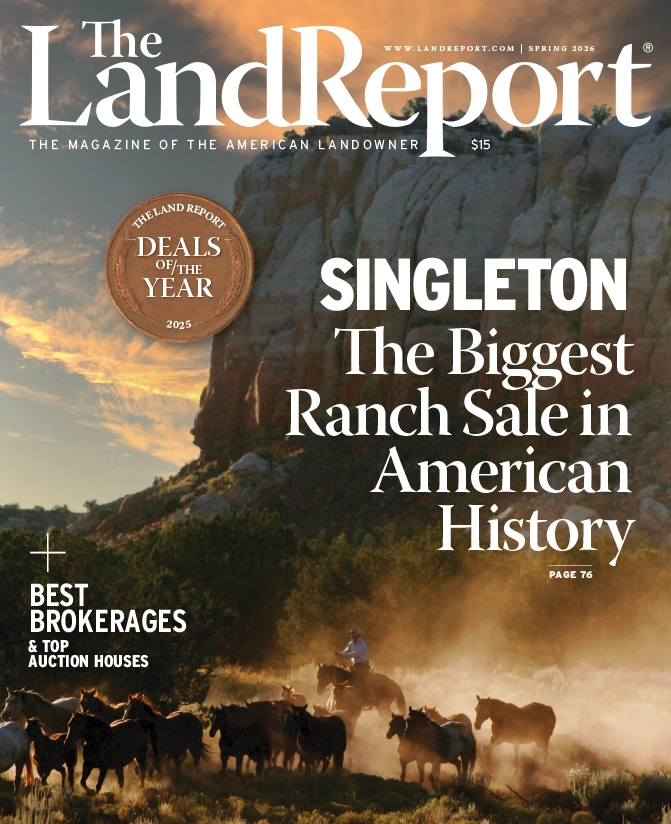
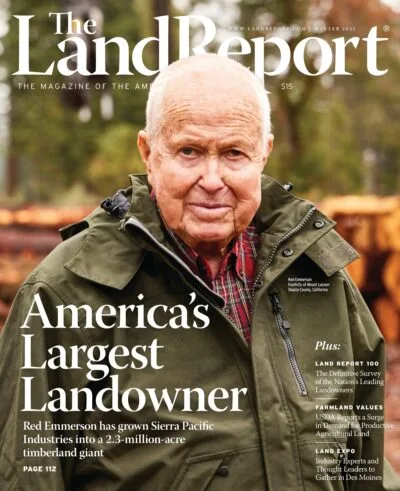
LR-cover-winter09Dear Landowner,

Are you interested in getting a heads up on market trends from industry experts such as Greg Fay? Want to see which stocks are bullish on land or find out why border collies might be right for your property?

You’re about to learn about these and much, much more courtesy of the most recent issue of The Land Report. Feel free to page through the digital version of the Magazine of the American Landowner via this link.

Of course if you prefer to hold something in your hands, we invite you to subscribe to our award-winning quarterly, which is available in a print version by subscription. And for those of you who are social media fans, get breaking news and up to the minute reports on Facebook and on Twitter. But no matter your preference,

Enjoy!
The Editors
www.LandReport.com
The Magazine of the American Landowner

Ask the Expert: Scott Jones

Ask the Expert: Scott Jones

The second session of the 111th Congress is already under way, and landowners have a lot at stake. With that in mind, The Land Report turns to Scott Jones to get the inside scoop on Washington’s next steps. Since 2003, Jones has been the CEO of the Forest Landowners Association (FLA), whose members own and operate some 40 million acres of forestland in 48 states. Founded in 1941, FLA offers education, information, and national grassroots advocacy with the goal of sustaining forestlands from one generation to the next.

With so many bold initiatives taken on by the Obama administration, what are the chances of a climate bill passing this year? Would it benefit forest landowners?

American voters believe that a climate/cap-and-trade bill may cost jobs; as a result, I would not be surprised to see the climate portion of the energy bill removed. If crafted properly, an energy bill could benefit private forest landowners by creating new markets for wood. However, the definition of “woody biomass” still needs to be fixed for landowners to truly benefit from the stripped down version of the bill.

The federal estate tax dropped to zero this year. Do you expect it to return to 55 percent with a $1 million exemption as scheduled in 2011?

There do not appear to be enough votes to bring the death tax back to life in 2010. Sen. Scott Brown’s (R-MA) recent election created a political barrier to retroactive death tax reinstatement. Unless legislative action is taken, the tax is scheduled to permanently return at a rate as high as 55 percent in 2011. But this is an election year, so anything is possible. Polls indicate 65 to 70 percent of Americans want the tax repealed.

Name one other issue landowners should follow closely.

The Clean Water Restoration Act is definitely legislation every landowner should keep an eye on. It seeks to expand the jurisdiction of the Clean Water Act by redefining “navigable waters” as “waters of the United States.” The consequences of this bill are enormous, and it has already created a firestorm in the Senate. Strong opposition convinced Rep. James Oberstar (D-MN) to delay introducing the bill on the House side. Oberstar now intends to move the bill through the House by the end of 2010.

Historic Dahlstrom Ranch Conservation Easement Finalized

Historic Dahlstrom Ranch Conservation Easement Finalized

A conservation easement of historic proportions was purchased in the heart of the Texas Hill Country only a short drive from the Capitol of Texas. Hays County, the City of Austin, and the Hill Country Conservancy (HCC), with funding from the federal Natural Resources Conservation Service (NRCS), came together to purchase a conservation easement on the historic Dahlstrom Ranch, a 2,254-acre privately-owned holding located outside of Buda. This rare collaboration between a private landowner, county, federal agency, and city took shape in 2007 and will be the first private land preservation agreement of its kind. The privately-owned ranch will have the unique distinction of providing a 384-acre area for public education and nature programs proposed by a public access committee led by the National Parks Service and managed by Hays County.

“Through this conservation easement, Gay Dahlstrom, in partnership with Hays County, as guided by Precinct 2 Commissioner Jeff Barton, NRCS, HCC, the City of Austin and many others, has ensured that a majestic piece of the Texas Hill Country will not only survive, but allow our native wildlife and natural resources to thrive,” said David Braun of Braun & Associates, attorneys for Gay Dahlstrom. “Gay is an exceedingly modest and private person, but today she and her family have set a proud and important example for all conservation-minded Texas landowners.” The family’s history on the property dates back five generations. The Dahlstrom Ranch on Onion Creek has played an impressive role in Hays County’s heritage. The property also plays a key role in the area’s overal well-being thanks to its abundant aquifer recharge. The historic ranch features an impressive system of caves and sinkholes that directly convey clean water to the aquifer. Also, following a reduction in livestock grazing in 2005, the ranch’s wildlife habitat and native grasses have staged a welcome comeback.

In recent years, the Dahlstroms, like many other Texas families, were faced with the decision on whether to begin selling off their land to developers in order to pay estate taxes. Gay Dahlstrom chose to preserve the family’s heritage and legacy, retaining Braun & Associates to guide her through the process of obtaining a conservation easement that enabled her family to keep the ranch intact. This contract between property owner and conservation organization, while providing critical tax incentives, also allows the owner to protect the water resources, wildlife habitat, natural character, and other conservation values of the land. A conservation easement restricts the amount and type of development allowed on the property, and conveys the right to enforce these restrictions in perpetuity, while preserving the right to traditional agricultural uses and limited residential use.

“This partnership provides multiple benefits, keeping this land intact for the family’s ongoing use and enjoyment while preserving the unique caves and other karst features of the ranch and furthering enhancement of its ecology and wildlife”, said Frank Davis, Director of Land Stewardship at HCC.

“I am very pleased we are able to partner with Hays County and Hill Country Conservancy on this important project,” said City of Austin Mayor Lee Leffingwell, a longtime supporter of the use of voter-approved bonds designated for the acquisition of open space.  “As our region continues to grow, it is important that we lead in the effort to protect our natural resources, and acquisitions like this one ensure we are doing our part to protect and enhance our environment, particularly our water quality, and the heritage of the Aquifer region and Texas Hill Country.”

Gay Dahlstrom’s son, Jack Dahlstrom Jr., has plans for ecotourism and nature and wildlife-related art exhibits on the property, with the ultimate goal to further the community’s understanding of, and respect for, the area’s heritage and environment. The Dahlstrom family has a long-term plan for continuing to restore the land and its native wildlife. “At the end of the day, my mother did this because she loves this land and appreciates all that it has given us,” said Jack Dahlstrom Jr. “Now, it’s our family’s turn to give back to the land, and we appreciate the efforts of everyone who worked so hard to help us make that happen.”

America’s Largest Landowner Announces Renewable Energy Venture

America's Largest Landowner Announces Renewable Energy Venture

Ted Turner has announced a strategic alliance with Atlanta-based Southern Company to pursue development of renewable energy projects in the Southwestern United States, including his New Mexico land holdings. Turner is the state’s largest landowner.

“I’ve always been passionate about developing renewable energy, and I’m excited to join forces with Southern Company to explore our renewable energy potential,” said Turner, who will pursue the venture through Turner Renewable Energy.

“Southern Company’s experience in power project development, construction and operations, and customer relations help make this a strong alliance, and I look forward to working together,” he added.

Turner Renewable Energy and Southern Company will focus on developing and investing in large scale solar photovoltaic projects in the Desert Southwest with the goal of further commercializing the technology and making it more cost competitive.

“This alliance unites our common goal to explore and develop new renewable energy projects,” said Southern Company CEO David Ratcliffe. “We have said for some time that renewable energy should play an increasing role in this country’s energy mix and that Southern Company would seek opportunities to expand our renewable portfolio where it makes sense. This is evidence of that commitment.”